
An excavator hydraulic pump supplies the oil flow required to operate the boom, arm, bucket, swing, travel, and auxiliary hydraulic functions. When the pump becomes worn or damaged, the machine may operate slowly, lose digging force, overheat, make abnormal noises, or become unable to build the required hydraulic pressure.
Finding a replacement pump may appear simple: search for the excavator model, compare the product photo, and place an order. In practice, that approach can easily lead to the wrong pump.
The same excavator model may use different pump configurations depending on its production year, serial-number range, regional specification, engine, control system, or original hydraulic component manufacturer. Two pumps may also look almost identical while using different shafts, regulators, valve plates, rotation directions, mounting flanges, or port arrangements.
The safest way to identify the correct pump is to combine the machine information, pump nameplate, OEM part number, full pump model code, physical configuration, and clear photos.
This guide explains what to check before ordering an excavator hydraulic pump and how to avoid expensive fitment mistakes.
Why the excavator model Is not enough
The machine model is an important starting point, but it should not be the only identification information.
For example, entering only:Hydraulic pump for PC200
does not tell the supplier:
- Which PC200 series is involved
- The machine serial-number range
- Which pump manufacturer was originally installed
- Whether the pump uses mechanical or electronic control
- Which shaft, flange, regulator, or port configuration is required
- Whether the customer needs the main pump, pilot pump, or another hydraulic pump
A more accurate way to request a quote should include the specific model number; it would be even better if the nameplate of the required pump could be provided.Because small model differences can indicate a different pump or control configuration.
Examples:
| Incomplete information | Better information |
|---|---|
| CAT 320 | Caterpillar 320D L |
| PC200 | Komatsu PC200-8 |
| ZX200 | Hitachi ZX200-3 |
| DX340 | Doosan DX340LCA |
| R210 | Hyundai R210-9 |
Step 1: Confirm which pump you need
An excavator may contain more than one hydraulic pump. Before checking part numbers, identify the function of the component being replaced.
Common pump types include:
- Main hydraulic pump
- Pilot pump
- Gear pump
- Steering pump
- Transmission pump
- Charge pump
- Fan pump
- Auxiliary pump
The main hydraulic pump normally supplies the primary working circuits. A smaller gear or pilot pump may supply pilot pressure, lubrication, cooling, steering, or another supporting function.
Do not assume every component described as a “hydraulic pump” is the main excavator pump.
Step 2: Locate the hydraulic pump nameplate
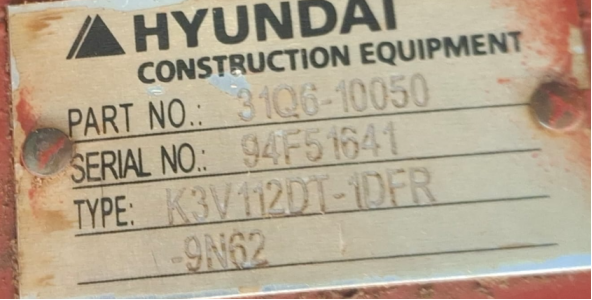
The pump nameplate is usually the most valuable identification source.
Depending on the manufacturer, it may include:
- Pump manufacturer
- Complete model code
- Assembly number
- Material number
- Serial number
- Manufacturing date or production code
- Displacement
- Rotation information
- Customer part number
- Machine manufacturer’s number
Official Danfoss service documentation explains that the complete model code defines the specific pump configuration and should be used when ordering service parts. Parker documentation similarly instructs customers to reference the model and serial numbers shown on the equipment nameplate.
A single incorrect character can point to another pump version.
Step 3: Record the complete pump model code
Do not shorten the model number.
For example:
| Incomplete information | Better information |
| K5V | K5V140DTP |
| A10 | A10VSO71DFR1 |
| MPV | MPV046 M46 |
| F11 | F11-250 |
| K3V | K3V63DTP |
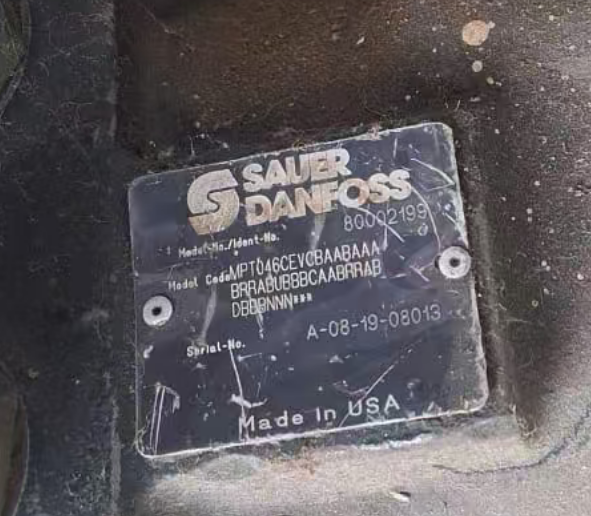
Step 4: Find the OEM part number
The hydraulic pump may have both:
- A hydraulic manufacturer’s model number
- A machine manufacturer’s OEM part number
The OEM part number may appear in:
- The excavator parts manual
- A label on the pump
- A number cast or stamped into the housing
- The packaging of the previous replacement pump
For example, FarinParts lists complete pumps using machine-related part numbers such as:
- 9121198 Hydraulic Main Pump for EX100-3 and EX120-3
- AT172900 Hydraulic Pump for John Deere 310E, 310G, 310J, 310K and 710D
- 400914-00295 Hydraulic Pump for Doosan DX340 and DX340LCA
- 319-6708 Piston Pump for Caterpillar M313, M314 and M315
These product examples show why the exact part number and complete application matter when searching for a replacement.
When several related numbers are visible, send all of them. One number may identify the complete pump, while another identifies a superseded version, customer configuration, or pump manufacturer assembly.
Step 5: Identify the pump manufacturer
Excavator hydraulic pumps may be produced by manufacturers such as:
- Kawasaki
- Bosch Rexroth
- Parker
- Danfoss or Sauer-Danfoss
- Nachi
- Kayaba
- Linde
- Eaton
- Uchida
- Yuken
- Nabtesco
The excavator brand and hydraulic pump brand may be different.
For example, the machine manufacturer may install a pump supplied by a specialist hydraulic manufacturer and assign its own part number to the complete assembly.
The machine part number is often useful when purchasing the complete pump. The hydraulic manufacturer’s model is especially useful when identifying internal parts, regulators, seal kits, and rotating-group components.
Step 6: Confirm the pump type and number of sections
Determine whether the old unit is:
- Single pump
- Tandem pump
- Double pump
- Triple pump
- Piston pump with attached gear pump
- Main pump with through drive
- Variable-displacement pump
- Fixed-displacement pump
A tandem excavator pump may have two main rotating groups and an additional pilot or gear pump.
Check:
- Number of pump sections
- Position of each section
- Number of regulators
- Number of drive shafts
- Attached pilot pump
- Through-drive arrangement
- Hose and port locations
Take photos from the front, rear, top, bottom, and both sides. A single product photo is rarely enough to confirm the complete configuration.
Step 7: Decide between a complete pump and repair parts
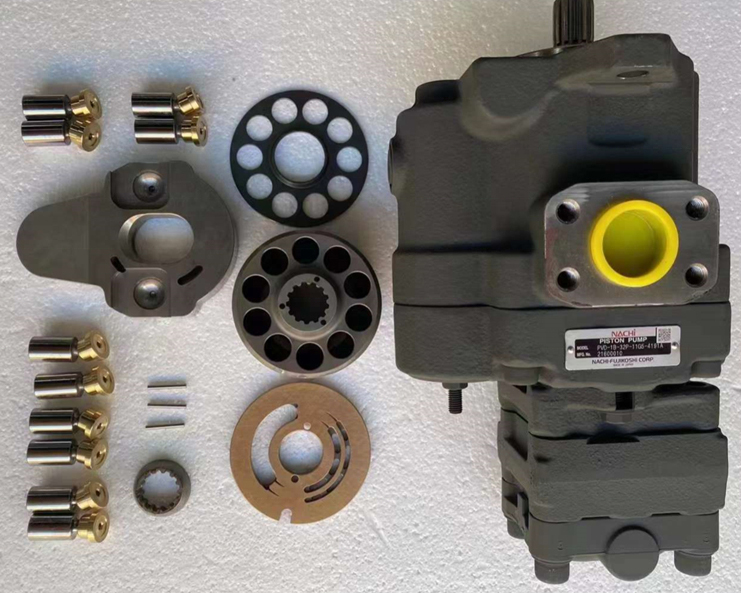
A complete replacement pump may be more suitable when:
- The housing is cracked
- The shaft or bearing seat is severely damaged
- Multiple internal groups have failed
- The regulator is damaged
- The machine must return to work quickly
- Local rebuilding equipment is unavailable
- The cost of parts and labor approaches the replacement cost
A repair may be suitable when:
- The housing is reusable
- The shaft and regulator remain serviceable
- Damage is limited to replaceable internal components
- The pump can be professionally assembled and tested
- The exact pump version is known
FarinParts supplies both complete hydraulic components and pump-specific repair parts. Browse the hydraulic parts category or read How to Find the Right Hydraulic Repair Kit for Your Machine when rebuilding the existing pump is being considered.
Common Hydraulic Pump Ordering Mistakes
Ordering Only by Machine Model
Machine models may cover more than one production period or hydraulic configuration.
Sending a Partial Pump Number
The missing suffix may identify a different shaft, regulator, rotation, or control option.
Comparing Only the Product Photo
Similar-looking pumps can have different internal and external configurations.
Ignoring the Machine Serial Number
The serial number may help separate earlier and later machine versions.
Assuming the Most Visible Number Is the Part Number
A casting number, regulator number, or housing number may not identify the complete pump.
Forgetting the Attached Gear or Pilot Pump
The main pump may require an attached supporting pump with a specific displacement and mounting position.
Ignoring Rotation
A wrong-rotation pump may not operate correctly and can be damaged.
Failing to Compare Ports and Connectors
The pump may bolt onto the machine while the hydraulic lines or electrical system do not match.
Replacing the Pump Without Diagnosing the System
Contamination, restricted suction flow, incorrect pressure settings, or valve leakage may damage the replacement or leave the original fault unresolved.
Frequently Asked Questions
Where is the hydraulic pump number located?
It is normally shown on a metal nameplate attached to the pump housing. Some pumps may also have stamped, engraved, or printed numbers on the housing or regulator.
Can I order an excavator hydraulic pump using only the machine model?
The model can begin the search, but it is not enough for reliable fitment confirmation. Provide the serial number, pump nameplate, part number, and photos whenever possible.
Is the cast number on the housing the hydraulic pump part number?
Not necessarily. A cast number may identify only the housing or casting design. It may not identify the complete pump configuration.
Is the OEM part number the same as the pump model?
Not always. The excavator manufacturer may assign an OEM part number to a pump produced by a separate hydraulic manufacturer.
Can two pumps with the same displacement be interchangeable?
Not automatically. They may have different rotation, controls, shafts, flanges, pressure ratings, or port arrangements.
Can I reuse the old pump regulator?
Possibly, but it should not be assumed. Regulator compatibility, wear, calibration, and pressure settings must be checked.
What should I do if the nameplate is missing?
Provide the complete machine model and serial number, OEM part number, parts-manual diagram, full pump photos, shaft and flange dimensions, port positions, regulator photos, and electrical connector details.
Should the hydraulic system be cleaned after a pump failure?
Yes. Metal particles and contaminated oil left in the tank, cooler, hoses, valves, cylinders, and motors can damage a replacement pump. Follow the machine manufacturer’s cleaning, flushing, filtration, oil-filling, priming, and startup procedures.
Find Excavator Hydraulic Pumps at FarinParts
FarinParts supplies replacement hydraulic pumps and related components for excavators, loaders, bulldozers, backhoe loaders, road machinery, agricultural equipment, and other heavy-duty machines.
Browse the FarinParts online shop by part number, pump model, machine model, or product name.
When the required pump is not listed online, send the machine plate, pump nameplate, part number, photos, and required quantity through the Parts Quote Request page.
Conclusion
Identifying the correct excavator hydraulic pump requires more than matching the machine model or product appearance.
For reliable fitment confirmation, collect:
- Complete machine model
- Machine serial number
- OEM part number
- Pump manufacturer
- Complete pump model code
The pump nameplate should be treated as one of the most important information sources. Official hydraulic manufacturer documentation consistently uses complete model codes, material numbers, and serial numbers to distinguish specific pump configurations and service parts.
Taking time to confirm these details can prevent incorrect parts, installation delays, additional freight costs, and unnecessary machine downtime.
Visit the FarinParts hydraulic pump parts category to search for complete pumps and repair components, or request a quote for professional fitment assistance.


