
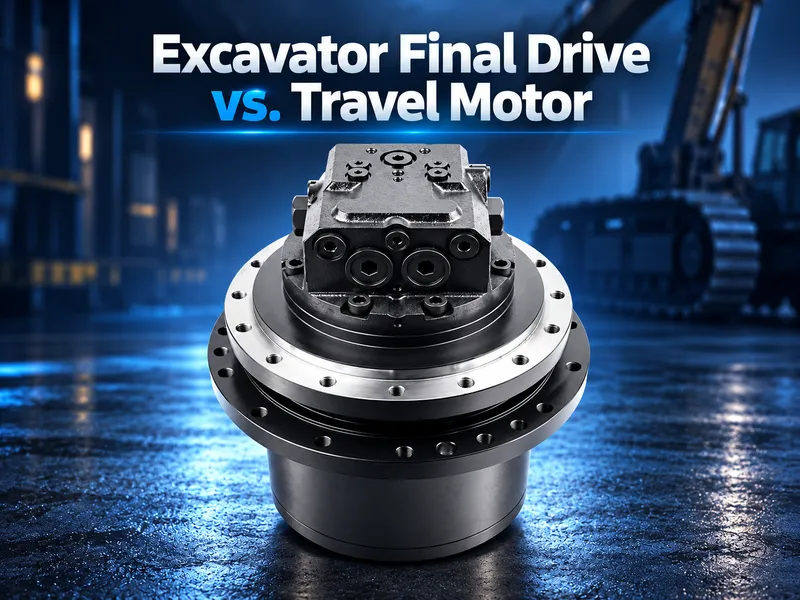
When an excavator starts having difficulty moving or making unusual noises, the problem may be with the final drive or travel motor. However, determining which component is causing the issue can be confusing. Although they are two completely different components, they are bolted together and work together to drive the excavator’s tracks.
Understanding the Excavator Final Drive vs Travel Motor difference can help you identify the faulty component, avoid ordering incorrect replacement parts, and reduce unnecessary equipment downtime.
Excavator Final Drive vs Travel Motor: Key Differences
| Comparison | Travel Motor | Final Drive |
|---|---|---|
| Main Function | Provides rotational power | Reduces speed and increases torque |
| Operating Principle | Hydraulic drive | Mechanical gear transmission |
| Power Input | High-pressure hydraulic oil | Rotational power from the travel motor |
| Power Output | Higher-speed rotational motion | Low-speed, high-torque output |
| Main Components | Pistons, cylinder block, valve plate, swash plate, etc. | Sun gear, planetary gears, ring gear, bearings, etc. |
| Power Source | High-pressure oil supplied by the hydraulic pump | Mechanical power from the travel motor |
| Lubrication | Hydraulic oil | Gear oil |
| Common Failures | Internal leakage, wear, weak rotation | Gear wear, abnormal noise, bearing damage |
| Repair Methods | Hydraulic testing, internal repair, or replacement | Inspection of gears, bearings, and seals |
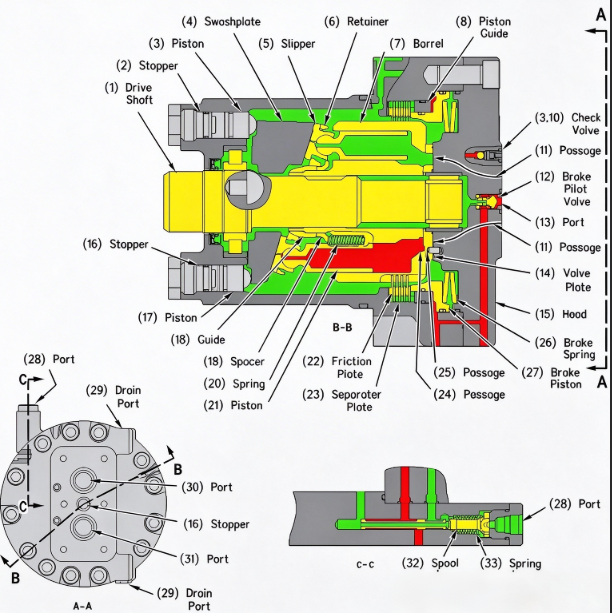
Excavator Travel Motor
The travel motor is a power conversion device in the excavator’s hydraulic travel system. It receives high-pressure hydraulic oil from the main hydraulic pump and uses hydraulic pressure to drive the internal piston mechanism, causing the output shaft to rotate.
Main functions:
- Provides power independently to the left and right tracks.
- Controls the rotational direction and speed of the two travel motors.
- Enables straight-line travel, steering, and counter-rotation.
Excavator Final Drive
The excavator final drive is the front section of the drive assembly, mounted on the outside of the track frame. It receives high-speed, low-torque rotational power from the travel motor’s output shaft and transfers it to the planetary gear mechanism.
Main functions:
- Reduces rotational speed so the drive sprocket rotates at an appropriate speed.
- Increases torque to provide the traction needed to move the tracks and the machine.
- Transfers mechanical power from the travel motor to the track drive sprocket.
Why Are the Final Drive and Travel Motor Assembled Together?
If a hydraulic motor were connected directly to an excavator’s tracks, the machine would have difficulty moving. Piston motors operate at relatively high speeds but cannot provide enough torque on their own to drive a multi-ton tracked excavator.
Without a reduction gearbox, a hydraulic motor capable of producing sufficient torque directly would need to be extremely large, potentially larger than the track frame itself.By combining a high-speed hydraulic travel motor with a planetary final drive gearbox, manufacturers can create a compact, efficient drive assembly capable of delivering enormous torque.
How to Identify Excavator Final Drive vs Travel Motor Problems?
| Symptoms | Possible Causes | What to Check First |
|---|---|---|
| One track has weak travel power | Motor internal leakage or insufficient hydraulic supply | Travel motor, control valve, swivel joint |
| Metallic grinding noise during travel | Worn gears or bearings | Final drive gearbox |
| Significantly reduced travel speed | Motor wear, dragging parking brake, etc. | Hydraulic motor and braking system |
| Gear oil leaking from final drive housing | Damaged floating seal or other seals | Gearbox seals |
| Severe vibration during travel | Gear, bearing, or undercarriage problems | Final drive and undercarriage |
| One track does not move at all | Motor, brake, gearbox, or hydraulic circuit failure | Complete travel system |
Inspection sequence:Initial fault inspection → Check for leaks → Inspect lubricants → Compare left and right track performance → Perform hydraulic tests → Inspect undercarriage components.
When comparing Excavator Final Drive vs Travel Motor problems, hydraulic performance issues often point toward the motor, while gear damage and bearing noise may indicate gearbox failure.
Excavator Final Drive vs. Travel Motor: How Do They Work Together?
STEP 1 : Main Hydraulic Pump
↓ Supplies hydraulic power to the travel circuit.
STEP 2 : Travel Control Valve and Swivel Joint
↓ Control hydraulic flow and direction and deliver hydraulic oil to the undercarriage.
STEP 3 : Travel Motor
↓ Converts hydraulic power into rotational mechanical power.
STEP 4 : Final Drive Gearbox
↓ Reduces rotational speed and increases torque.
STEP 5 : Drive Sprocket and Tracks
↓ Convert mechanical power into excavator travel movement.
How to Choose the Right Travel Motor, Final Drive Gearbox, or Complete Final Drive Assembly?
Choosing the correct replacement part starts with identifying what you actually need: a hydraulic travel motor, a planetary reduction gearbox, or a complete final drive assembly.
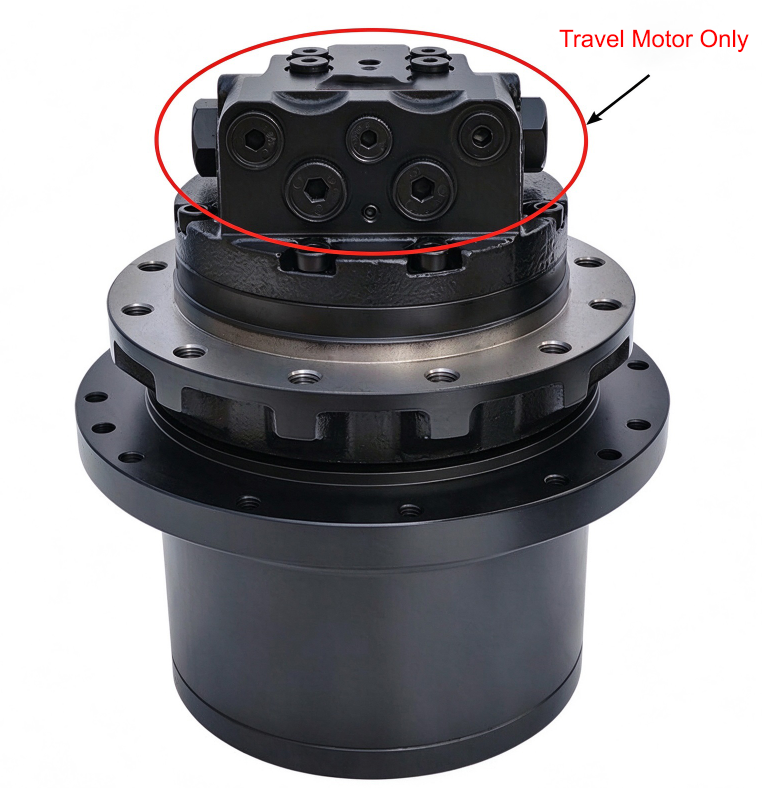
Travel Motor Only
This is the hydraulic motor section without the planetary reduction gearbox.
Choose this option when the existing hydraulic motor has internal leakage, damaged pistons, or other confirmed hydraulic failures, while the gearbox remains in good condition.
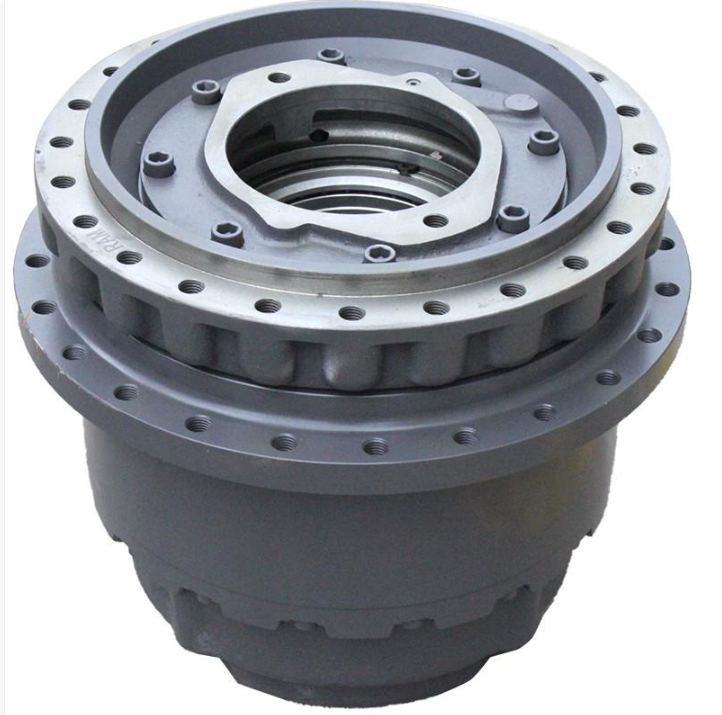
Final Drive Gearbox Only
This is the mechanical reduction unit, usually containing planetary gears, bearings, housing, and seals.
Consider this option when the gearbox has damaged gears, excessive bearing wear, or other mechanical failures, but the hydraulic motor is still functioning properly.
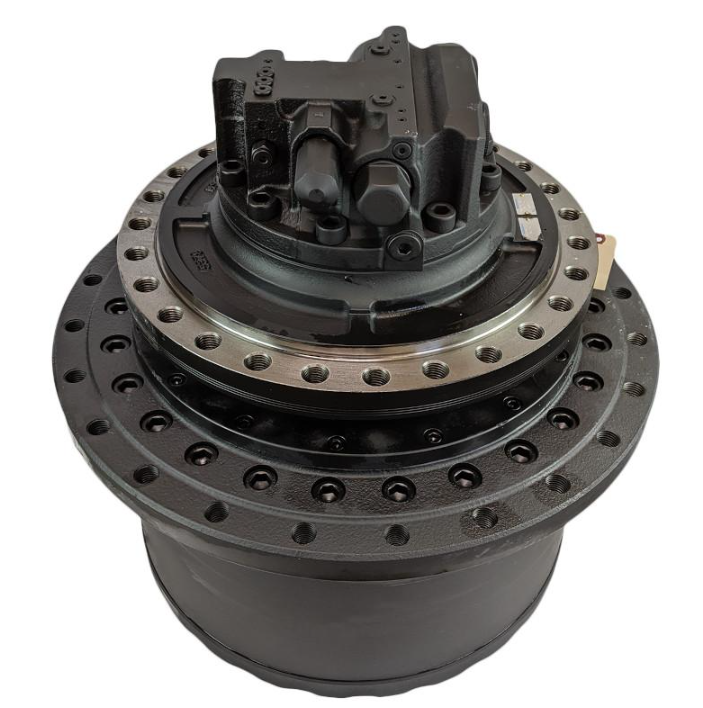
Complete Final Drive Assembly
This normally includes both the hydraulic travel motor and planetary reduction gearbox.
This may be the better choice when both sections are damaged, the original components are severely worn, or replacing the complete assembly is more economical than replacing individual sections.
FAQ
Why Does One Excavator Track Move While the Other Does Not?
Possible causes include travel motor failure, final drive gearbox damage, hydraulic control problems, parking brake failure, or excessive mechanical resistance.
Why Are Final Drives and Travel Motors Often Confused?
On excavators, these two components are almost always sold and replaced as a single bolted assembly. When purchasing replacement parts, customers often receive a fully assembled unit containing both the hydraulic motor and planetary gearbox. Over time, the two terms have become interchangeable in the parts market.
Can You Replace Only the Travel Motor and Keep the Existing Final Drive?
Mechanically, the hydraulic travel motor and planetary gearbox can be separated. However, doing so is often not cost-effective and is generally not recommended.
Finding a standalone aftermarket motor or gearbox that perfectly matches the existing component can be difficult. Poor compatibility may cause gear misalignment and rapid component damage.
Do the Travel Motor and Gearbox Use the Same Oil?
No. The travel motor uses hydraulic oil circulated by the excavator’s main hydraulic pump for operation and lubrication.
The planetary gearbox is a separate, sealed chamber filled with heavy-duty gear oil to lubricate its heavily loaded gears.
How Can You Tell Whether the Problem Is in the Travel Motor or Final Drive?
If you hear high-pitched whining or grinding noises, or notice thick, dark oil leaking near the drive sprocket, the planetary gearbox may be faulty.
If the excavator pulls to one side, has weak travel power under load, or leaks thin, amber-colored hydraulic oil near the motor’s rear cover, the hydraulic travel motor may have internal leakage or a damaged shaft seal.
Conclusion
The hydraulic travel motor converts hydraulic power into rotational motion, while the reduction gearbox increases torque and transfers power to the drive sprocket. When these components work together correctly, the excavator can travel, maneuver, and operate under demanding ground conditions.
When problems occur, identifying the actual cause is essential. Slow travel, unusual noises, overheating, and oil leaks may indicate problems with the drive assembly, but similar symptoms can also originate elsewhere in the hydraulic or travel system.
At FarinParts, we supply replacement parts for a wide range of equipment. Our team can help you identify the correct replacement components and verify relevant specifications before you place an order. If your equipment is experiencing problems, contact the FarinParts team for assistance.


