

One of the biggest challenges when purchasing excavator parts is figuring out how to find the right excavator parts.
Even excavators of the same brand and model may require completely different parts depending on the year of manufacture, machine serial number, engine configuration, or hydraulic system version.
Therefore, correctly identifying the excavator model, machine serial number, and original equipment part number is one of the most important steps when purchasing replacement parts.
This article will explain how to identify excavator parts, look up OEM part numbers, determine the compatibility of replacement parts, and find suitable replacements when the part number is unavailable.
Why is an accurate part number required when purchasing excavator parts?
An excavator consists of multiple components, including the engine, hydraulic system, undercarriage, swing system, and work equipment. These systems contain a large number of parts, many of which look similar but differ in internal structure and technical specifications.
For example:
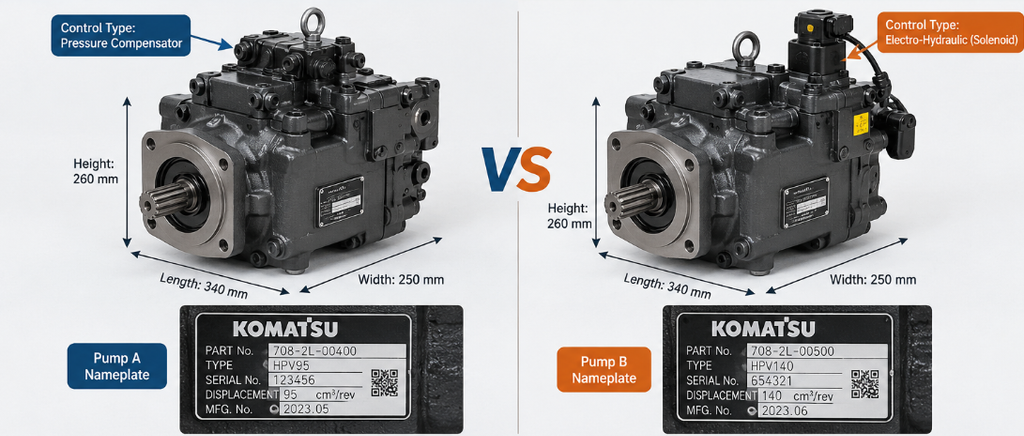
- Two hydraulic pumps may have the same external dimensions but differ in displacement and control methods.
- Two diesel fuel injectors may look identical, but their injection characteristics and calibration codes differ.
- Two turbochargers may be compatible with the same engine, but their specifications and actuator configurations differ.
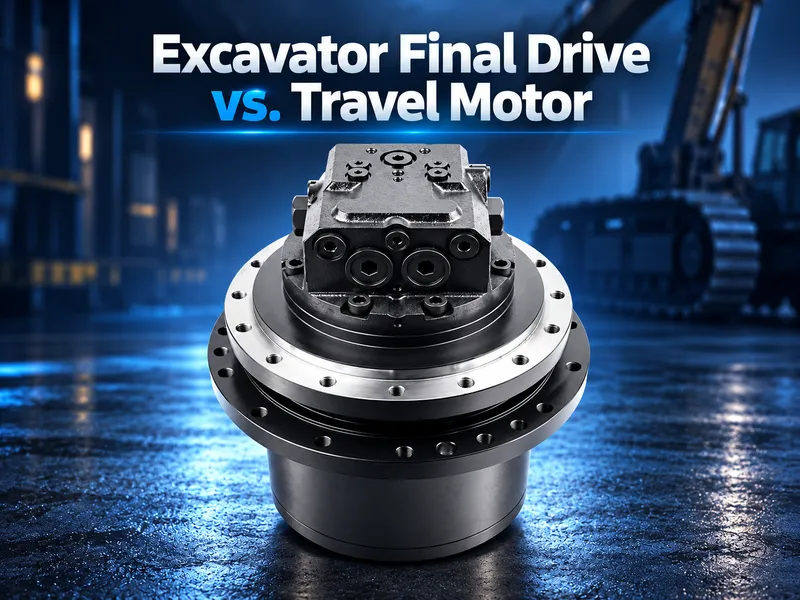
- Two travel motors may have similar mounting flanges but use different gear ratios or braking mechanisms.
Therefore, compatibility cannot be determined based solely on a part’s appearance. An accurate part number helps purchasers narrow their search and reduce the risk of purchasing the wrong part.
How can I confirm the exact model of an excavator?
When searching for excavator parts, the first step is to determine the machine’s full model number—not just the brand name.
Common excavator brands include:
| Brand | Examples of common models |
| Caterpillar | 320D、320GC、336D |
| Komatsu | PC200-6、PC200-8、PC210LC-10 |
| Hitachi | ZX200-3、ZX210-5G、EX200-5 |
| Volvo | EC210B、EC220D、EC300D |
| Hyundai | R210LC-7、R220LC-9 |
| Kobelco | SK200-8、SK210-10 |
| Doosan / Develon | DX225LC、DX300LC |
| Kubota | KX057-4、U55-4 |
| SANY | SY215C、SY365H |
How do I find the serial number of an excavator?
The serial number is usually more important than the model number.
Excavators of the same model may have undergone multiple design updates during the manufacturing process.
Therefore, the serial number helps identify the specific production batch and configuration.
Locating the equipment nameplate
Most excavators are equipped with a manufacturer’s nameplate.
The nameplate typically contains the following information:
- Manufacturer
- Model
- Serial Number
- Product Identification Number
- Manufacturing Year
- Operating Weight
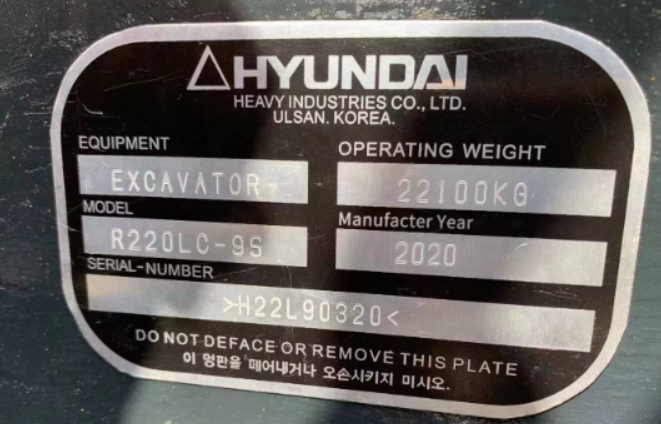
Common locations include the outside of the cab, structural components of the chassis, and the rotating platform.
How to distinguish equipment serial number from engine number?
The equipment serial number and the engine number are not the same thing.
For example:
An excavator may have a specific Komatsu equipment serial number, but its engine has a separate Cummins engine serial number.
When purchasing different types of accessories, you need to use different identification information.
| Part Type | Required Identification Information |
|---|---|
| Hydraulic Pump | Equipment model, serial number, and hydraulic pump nameplate |
| Travel Motor | Equipment model, serial number, and travel motor model number |
| Fuel Injector | Engine model, engine serial number, and injector part number |
| Turbocharger | Engine model and turbocharger nameplate number |
| Alternator | Engine model and original alternator part number |
| Starter Motor | Engine model and original starter motor part number |
| Hydraulic Seals | Hydraulic cylinder model, seal dimensions, or seal kit part number |
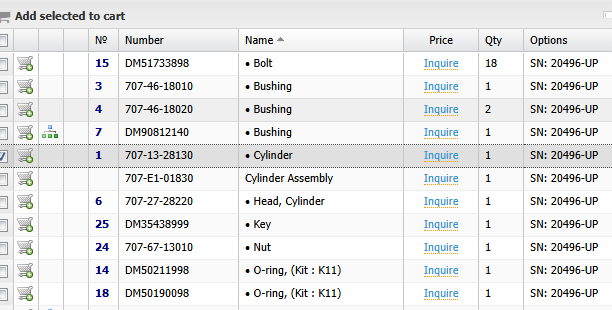
What is an original part number?
An original part number is typically a number used by a manufacturer to identify a specific part.
In the construction equipment parts industry, terms such as “OEM Number,” “Part Number,” or “Original Part Number” are frequently used for part lookups.
These numbers help identify a part’s original application and potential replacement options.
What is the difference between an original part number and an aftermarket part number?
Original parts are typically sold through the equipment manufacturer’s own parts distribution system.
Aftermarket replacement parts, by contrast, may be produced by independent manufacturers and assigned their own unique product codes.
How to find the right excavator parts using part numbers?
If the old parts still have clear part numbers, it is usually easier to find replacement parts.
Step 1: Record the complete part number
Check the nameplate, metal housing, or label on the old part.
We recommend taking a photo of the entire nameplate to ensure all numbers and letters are clearly visible.
Step 2: Search the original manufacturer’s parts catalog
Manufacturers’ electronic parts catalogs typically allow you to search for parts by device model and serial number.
Step 3: Check for any supersession or replacement information for the part number
When original equipment parts are discontinued, the manufacturer may provide new replacement part numbers.
Step 4: Verify the technical specifications of the parts
For parts with relatively simple structures, the focus should be on verifying the external dimensions and mounting features.
For complex components such as hydraulic pumps, motors, and fuel injectors, it is also necessary to verify the relevant technical specifications.
Brand Search Pages
For Caterpillar:CAT Parts Store
For Volvo:Volvo CE Parts
For Kobelco: Kobelco Parts & Service
For Case:CASE Parts
For JCB: JCB Parts
For Kubota:Kubota Parts Lookup
For Bobcat:Bobcat Parts Catalog
For John Deere:John Deere Parts Catalog
For Sany :SANY Parts
For Liebherr:MyLiebherr
If you don’t have a part number, how do you find the right excavator parts?
During actual maintenance, the part numbers on old parts may be worn, corroded, or completely unreadable—a situation that is particularly common on excavators that have been in service for a long time. If you cannot find the part number, you can identify it using the following methods.
Provide the complete equipment model number
First, confirm the brand, model, and serial number.
For example: Komatsu PC200-8
If you can provide the complete equipment serial number, the supplier will be able to further narrow down the range of available parts.
Take photos of the old part
- Overall appearance of the part
- Front and back views
- Installation location
- Connection interfaces
- Nameplate or casting number
Measure Key Dimensions
If a reliable part number is unavailable, dimensional information can serve as a key identifier.
Different types of parts require measurements of different parameters.
For example, for hydraulic oil seals, it is typically necessary to verify the inner diameter, outer diameter, thickness, and sealing cross-section structure.
For bushings, it may be necessary to verify the inner diameter, outer diameter, length, and material requirements.
Confirm the Part’s Installation Location on the Equipment
Providing photos of the part’s installation location usually helps determine which system the part belongs to.
What should you consider when purchasing a hydraulic pump for an excavator?
The hydraulic pump is a critical component of an excavator’s hydraulic system.
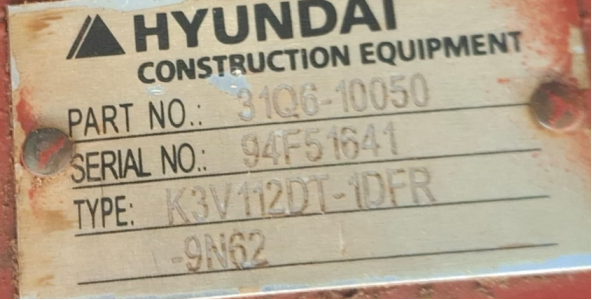
When purchasing a hydraulic pump, in addition to verifying the equipment model, you should also inspect the manufacturer’s nameplate on the pump body.
For some hydraulic pumps, the nameplate can provide more direct identification information than the equipment model.
It is essential to verify the hydraulic pump’s complete model number, control method, direction of rotation, mounting configuration, and interface configuration.
If the hydraulic pump has been replaced on the original equipment, you should also check whether the currently installed pump matches the equipment’s original configuration.
Reference Guide:How to identify the correct hydraulic pump for your excavator
When purchasing diesel engine parts, why is the engine part number still required?
Excavator engines may be manufactured by the equipment manufacturer itself or supplied by an independent engine manufacturer.
For example, some construction machinery is equipped with diesel engines from Cummins, Isuzu, Mitsubishi, Yanmar, or other brands.
Therefore, when searching for engine parts, it is essential to distinguish between the equipment model and the engine model.
When placing an order, please provide the following:
- Engine brand
- Full engine model number
- Engine serial number
- Original part number
- Photo of the part nameplate
How should you choose between original parts and aftermarket replacement parts?
When purchasing replacement parts for excavators, many people compare original equipment manufacturer parts with aftermarket replacement parts.
Each has its own suitable application scenarios.
| Comparison | ORIGINAL Parts | Aftermarket Replacement Parts |
|---|---|---|
| Price | Generally higher | More pricing options available |
| Supply Channels | Authorized dealers and OEM distribution networks | Independent manufacturers and parts suppliers |
| Product Options | Based on original equipment specifications | Wide range of brands, quality levels, and prices |
| Compatibility Verification | Verified through OEM parts catalogs and equipment information | Requires cross-referencing part numbers and technical specifications |
| Product Quality | Manufactured to OEM quality standards | Varies depending on the manufacturer |
| Lead Time | Depends on stock availability | Depends on supplier inventory and production schedules |
Tips:Aftermarket replacement parts are not necessarily of lower quality; some specialized manufacturers offer reliable replacement parts that meet specific repair needs.
5 common mistakes when buying excavator parts.
- Providing only the equipment model
- Purchasing parts based solely on appearance
- Ignoring updates to original equipment part numbers
- Failing to confirm the specific model of the engine or hydraulic pump
- Focusing only on price and ignoring compatibility
How can you improve procurement efficiency and find the right excavator parts?
It is very helpful to maintain a comprehensive record of equipment and parts; keep the following information on hand for each piece of equipment.
- Equipment brand and model
- Equipment serial number
- Engine model
- Hydraulic pump model
- Original part number
- Historical maintenance records
- Photos of the part
How do I request a price quote from a parts supplier?
If you need to purchase replacement parts for an excavator, we recommend providing as much information as possible all at once.
The following is a complete list of quotation documents.
Equipment Information
- Brand
- Model
- Serial Number
Parts Information
- Part Name
- Part Number
- Quantity
- Photos
For engine parts, please also provide the engine model and serial number.
For hydraulic pumps, motors, and other complex assemblies, we recommend providing photos of both the nameplate and the mounting interface.
Complete quotation information reduces the need for back-and-forth communication and helps suppliers more accurately assess compatibility.
FAQ
How do I look up an excavator’s original equipment part number?
For excavator parts, you can use the electronic parts catalog provided by the equipment manufacturer to look up the corresponding part drawings and part numbers based on the complete equipment model and serial number.
Can excavators of the same model use the same parts?
Not necessarily. Even within the same model, there may be differences in production batches, emissions configurations, or technical updates.
Can I still purchase replacement parts after an original part number has been discontinued?
Some discontinued parts can be replaced using updated part numbers from the manufacturer or aftermarket alternatives.
Can I purchase excavator parts without a part number?
If the part number for an excavator part is unavailable, you can try to identify it using the equipment model, serial number, photos of the old part, dimensions, and mounting configuration.
However, for complex hydraulic assemblies and electronic control components, more detailed technical information may still be required.
How can I determine if aftermarket excavator parts are reliable?
Check the manufacturer’s documentation, compatibility information, warranty terms, and the supplier’s technical support capabilities.
How can I avoid purchasing the wrong excavator parts?
Before purchasing excavator parts, you should at least verify the equipment model, serial number, and original part number.
Conclusion
Finding the right excavator parts involves more than just searching for a product name.
Accurately identifying excavator parts usually requires combining information such as the equipment model, serial number, original equipment manufacturer (OEM) part number, and details about the actual assembly in which the part is installed.
Completing these checks before purchasing helps reduce incorrect orders, shorten repair wait times, and lower additional costs resulting from incompatible parts.
Farinparts offers a wide range of construction machinery engine parts, hydraulic system components, and other replacement parts. If you are unable to confirm the correct part number, please provide the equipment model, serial number, old part number, and photos, and our team will assist you in verifying product information and available models.