

An excavator consists of several major systems that work together to perform tasks such as digging, lifting, rotating, and moving heavy loads. Understanding the various components of an excavator helps equipment owners, operators, and maintenance personnel identify specific parts, detect potential malfunctions, and select the correct replacement parts.
The main parts of excavator include: the boom, dipper arm, bucket, hydraulic cylinders, hydraulic pumps, engine, swing motor, travel motor, final drive, and undercarriage components.
Although excavators from different brands—such as Komatsu, Caterpillar, Hitachi, Hyundai, Volvo, and Kobelco—may differ in appearance, the basic design of most conventional hydraulic excavators is largely similar.
In this guide, we will explore the 20 main parts of excavator, explain their functions and locations, and discuss common issues that may require repair or replacement.
What Are the Main Parts of Excavator Machines?
The main components of an excavator can be divided into four major systems:
- Working mechanism: Includes the boom, dipper arm, bucket, hydraulic cylinders, and bucket linkage.
- Upper Structure: Includes the cab, engine, counterweight, and slewing mechanism.
- Hydraulic System: Includes the hydraulic pump, control valves, hydraulic motors, and related components.
- Lower Structure: Includes the tracks, idler wheels, guide wheels, drive wheels, and travel drive assembly.
20 Main Parts of Excavator: Names and Functions
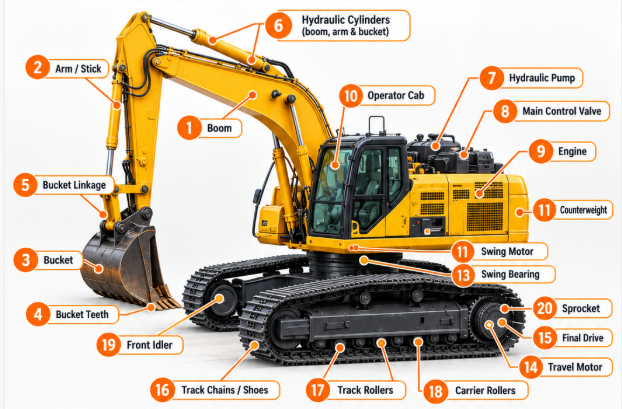
The parts of excavator diagram below shows the location of major components, including the boom, arm, bucket, hydraulic cylinders, operator cab, swing mechanism, and undercarriage. Understanding these components helps mechanics identify damaged parts and select suitable replacement components.
Parts of Excavator Diagram: Main Components Explained
| No. | Excavator Part | Main Function | Common Problems |
|---|---|---|---|
| 1 | Boom | Raises and lowers the front attachment | Cracks, pin wear |
| 2 | Arm | Extends and retracts the bucket | Bushing wear, structural damage |
| 3 | Bucket | Digs and carries materials | Tooth wear, cracks |
| 4 | Bucket Teeth | Penetrate soil and rock | Wear, breakage |
| 5 | Bucket Linkage | Transfers force to the bucket | Pin and bushing wear |
| 6 | Hydraulic Cylinders | Move the boom, arm, and bucket | Oil leakage, internal bypass |
| 7 | Hydraulic Pump | Supplies hydraulic oil flow | Wear, overheating, low output |
| 8 | Main Control Valve | Directs hydraulic flow | Sticking spools, leakage |
| 9 | Engine | Provides mechanical power | Overheating, starting problems |
| 10 | Operator Cab | Houses operator controls | Electrical and control issues |
| 11 | Counterweight | Balances the machine | Mounting damage |
| 12 | Swing Motor | Powers upper-structure rotation | Leakage, weak swing |
| 13 | Swing Bearing | Supports rotation of the upper structure | Excessive play, bearing wear |
| 14 | Travel Motor | Powers track movement | Internal wear, weak travel |
| 15 | Final Drive | Reduces speed and increases drive torque | Gear and bearing damage |
| 16 | Track Chains | Support and move the machine | Track wear, loose components |
| 17 | Track Rollers | Support the moving track system | Bearing wear, oil leakage |
| 18 | Carrier Rollers | Support the upper track run | Seized rollers, uneven wear |
| 19 | Front Idler | Guides the track chain | Bearing wear, tracking problems |
| 20 | Sprocket | Engages the track chain and drives it | Tooth wear, uneven engagement |
The following table provides a complete overview of the 20 main parts of excavator machines, their primary functions, and common problems. This excavator parts list can be used as a quick reference when inspecting equipment, diagnosing mechanical issues, or identifying replacement parts.
Hydraulic Cylinders
Hydraulic cylinders convert hydraulic pressure into linear movement.
Most conventional excavators have three main types of working-equipment cylinders:
- Boom Cylinders: Raise and lower the boom.
- Arm Cylinders: Extend and retract the stick.
- Bucket Cylinders: Control bucket curling and dumping movements.
Hydraulic cylinder parts:
- Cylinder
- Piston rod
- Piston
- Rod seals
- Piston seals
- Wear rings
- Guide bushings
Common Hydraulic Cylinder Problems:
- Cylinder drift under load
- Slow or weak movement
- Scratched or bent piston rods
- Damaged seals
- Abnormal movement or noise
External oil leakage is one of the most visible signs of hydraulic cylinder problems.
Hydraulic Pump
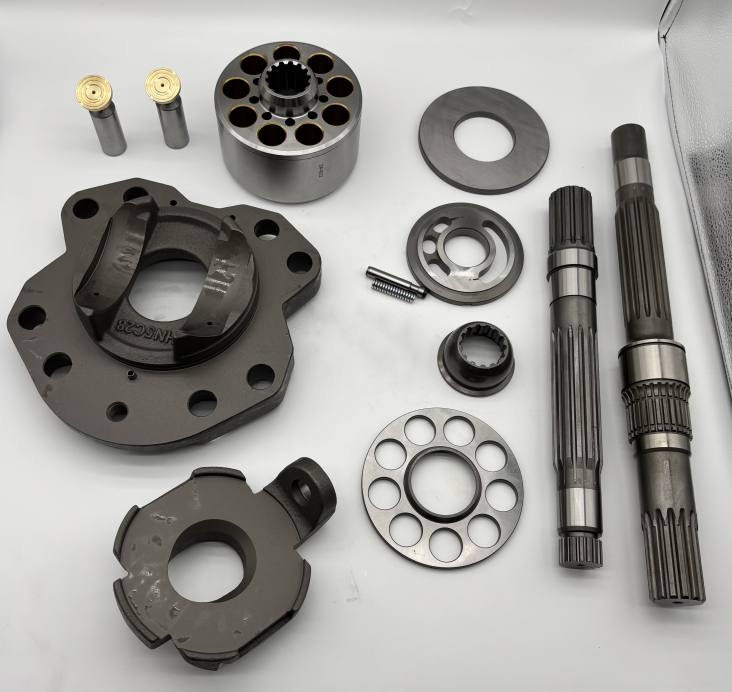
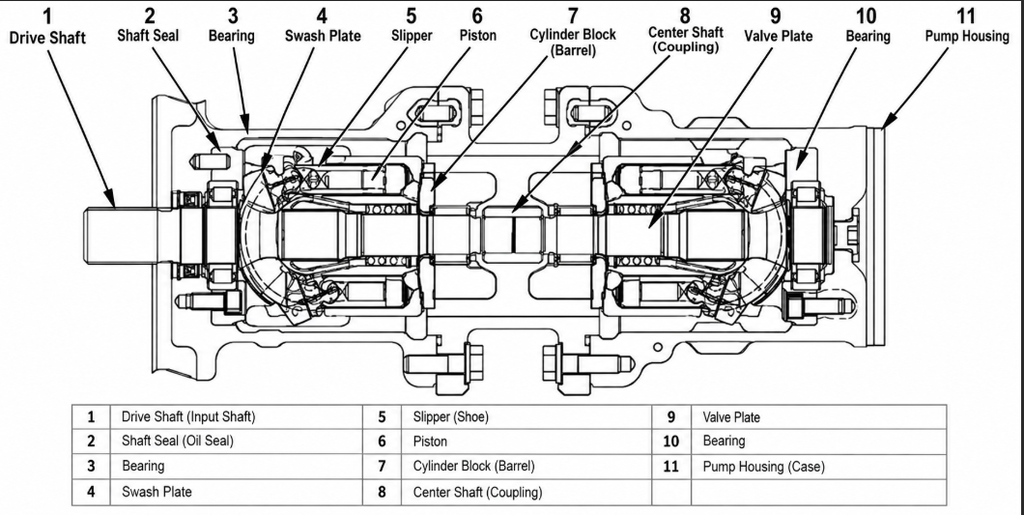
The hydraulic pump is one of the most important components in an excavator’s hydraulic system.Hydraulic pumps supply oil to the circuits that operate the boom, arm, bucket, swing motor, travel motors, and auxiliary equipment.
Hydraulic Pump Parts:
- Drive shaft
- Cylinder block
- Piston shoe
- Valve plate
- Retainer plate
- Swash plate
- Bearings
- Shaft seals
- Control regulator
Signs of Hydraulic Pump Problems:
- Slow hydraulic movement
- Weak digging or lifting performance
- Unusual pump noise
- Excessive hydraulic oil temperature
- Increased internal leakage
- Hydraulic pressure or flow below specification
Related Guide: How to Identify the Correct Excavator Hydraulic Pump
Related Guide: 10 Signs of a Failing Excavator Hydraulic Pump
Main Control Valve
The main control valve directs hydraulic oil to the different working functions of the excavator.Modern excavators may use hydraulic pilot controls, electronic controls, or a combination of both.
Common Main Control Valve Problems:
- Stuck or Damaged Valve Spool
- Internal Leakage
- External Oil Leakage
- Damaged Seals
- Control Signal Failure
- Wear Caused by Contaminants
Engine
The engine provides the mechanical power required for the excavator to operate.
Engine parts:
- Cylinder block
- Cylinder head
- Piston
- Crankshaft
- Camshaft
- Fuel injector
- Turbocharger
- Cooling system components
- Lubrication system components
Operator Cab
The operator’s cab provides a working environment for operating the excavator.
Operator Cab parts:
- Seat
- Control lever
- Travel pedals or control lever
- Display
- Electronic control unit
- Safety switch
- Climate control system
Swing Motor
A swing motor is a type of hydraulic motor responsible for driving the rotation of an excavator’s upper structure.
It drives the swing mechanism through a reduction gearbox and by meshing with the gears of the swing bearing.
Signs of Swing Motor Failure
Common Swing Motor Problems:
- Slow swing speed
- Weak swing power
- Abnormal noise
- Hydraulic fluid leakage
- Excessive return flow from the motor housing
- Rotation braking issues
Slewing Bearings
Slewing bearings are used to support the upper rotating structure.They allow the upper structure to rotate relative to the lower travel mechanism while withstanding heavy operational loads.
Common Swing Bearing Problems:
- Excessive rotational play
- Abnormal grinding or knocking noises
- Damage to gear teeth
- Lubrication issues
- Damaged seals
- Wear on bearing raceways
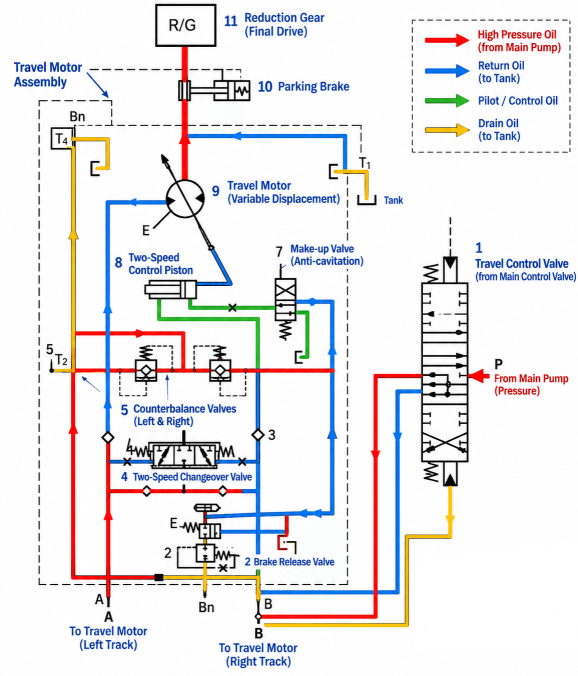
Travel Motor
Travel motors provide the hydraulic power required for an excavator to move.Most crawler excavators are equipped with two travel motors, one for each side of the track.
Hydraulic oil drives the travel motors, which transmit torque through the final drive gearbox.
Signs of Travel Motor Problems:
- One track moves more slowly than the other.
- The excavator struggles when climbing an incline.
- Travel speed is inconsistent.
- Unusual noises occur during travel.
- Hydraulic fluid leaks around the motor.
Related Guide: Excavator Travel Motor Problems: Causes and Troubleshooting
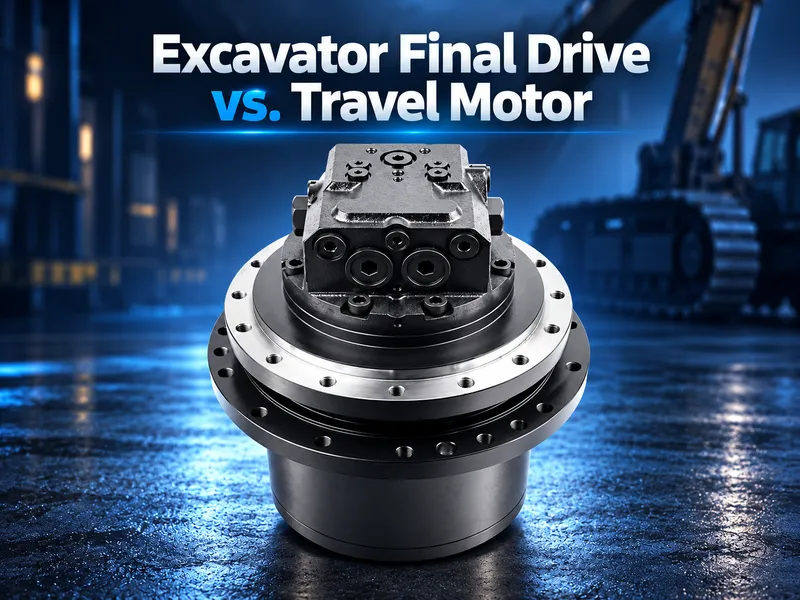
Final Drive
The final drive is a reduction gearbox that transmits torque from the motor to the track drive sprocket.It reduces the rotational speed and increases the effective torque used to propel the machine.
Final Drive Parts:
- Planetary gears
- Sun gear
- Ring gear
- Bearings
- Shafts or carriers
- Housing
- Seals
Common Final Drive Problems:
- Gear damage
- Bearing wear
- Oil seal leakage
- Gear oil contamination
- Excessive gear backlash
- Mechanical damage caused by insufficient lubrication
For a more detailed explanation, read Excavator Final Drive vs. Travel Motor: What’s the Difference?
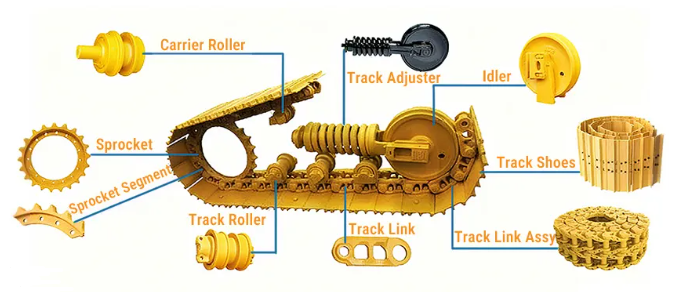
Chassis Components
Track Chains and Track Shoes
The track system supports the excavator, enabling it to travel over soft or uneven terrain.
Common Track Problems:
- Excessive wear on track chains
- Loose or damaged track shoes
- Wear on pins and bushings
- Improper track tension
- Track misalignment
- Improper track tension accelerates wear on undercarriage components.
Track Rollers
Track rollers bear the machine’s weight and guide the lower section of the track chain.
Common Track Roller Problems:
- Bearing wear
- Oil seal leakage
- Seized rollers
- Uneven running-surface wear.
Carrier Rollers
Carrier rollers support the upper run of the track chain.Their main purpose is to help maintain track alignment and reduce excessive track sag.
Common Carrier Rollers problems :
- Bearing damage
- Oil leakage
- Seized rollers
- Excessive wear
- Misalignment
Front Idler
The front idler guides the track chain around the front end of the undercarriage.
Common Front Idler Problems:
- Worn running surfaces
- Damaged bearings
- Seal leakage
- Track misalignment
- Excessive side movement
Sprocket
The sprocket is the toothed wheel driven by the final drive assembly.It engages the track chain and transfers drive torque into track movement.
Signs of Sprocket Wear:
- Hooked or pointed sprocket teeth
- Uneven tooth wear
- Poor track-chain engagement
- Abnormal noise
- Accelerated track chain wear
How Do the Hydraulic Components of an Excavator Work Together?
The hydraulic system connects many of the most important components in an excavator.
In a conventional hydraulic excavator, the workflow is roughly as follows:
Engine → Hydraulic pump → Main control valve → Hydraulic cylinder or hydraulic motor → Return line → Hydraulic oil tank
Common Problems with Excavator Parts and Their Symptoms
| Excavator Symptom | Possible Components | Recommended Initial Check |
|---|---|---|
| Boom lifts slowly | Hydraulic pump, boom cylinder, control valve | Check oil supply, pressure, flow, and leakage |
| Weak digging force | Hydraulic pump, arm cylinder, relief valve | Compare hydraulic performance with specifications |
| Bucket movement is abnormal | Bucket cylinder, linkage, control valve | Inspect pins, bushings, and hydraulic operation |
| One track moves slowly | Travel motor, final drive, swivel joint | Check travel pressure, motor performance, and mechanical resistance |
| Upper structure swings slowly | Swing motor, swing brake, control valve | Inspect swing circuit and drive components |
| Hydraulic oil overheats | Pump, valves, cooler, hydraulic system | Check oil condition, cooling, and internal leakage |
| Oil leaks from a cylinder | Cylinder seals, rod, fittings | Identify the actual leakage location |
| Track derails frequently | Track adjuster, idler, rollers, chain | Inspect alignment, tension, and wear |
| Grinding noise during travel | Final drive, bearings, track components | Check gearbox oil and mechanical condition |
| Excessive bucket play | Pins, bushings, bucket linkage | Measure joint clearance |
If the excavator has multiple slow or weak functions, read our Excavator Hydraulic Troubleshooting Guide before replacing the pump or control valve.
How to Determine the Correct Replacement Parts for Excavator?
Before purchasing replacement parts, please verify the following information.
- Original part number
- Excavator brand and model
- Hydraulic pump or motor model (if applicable)
- Photos of the old part
Finding the right replacement parts requires more than just searching for generic excavator part names.
At FarinParts, we help equipment owners, repair shops, and parts buyers find the exact replacement parts they need for all types of excavators and construction machinery.
Our product range includes hydraulic pumps, hydraulic motors, final drives, swing motors, control valves, hydraulic repair kits, seal kits, and various other excavator replacement parts.
You can check out our Excavator Hydraulic Parts collection or browse our full range of replacement parts.
Which Parts of Excavator Machines Need Regular Replacement?
Some excavator components are designed to wear during normal operation.
| Component | Typical Maintenance or Replacement Consideration |
|---|---|
| Bucket Teeth | Replace when worn, cracked, or damaged |
| Pins and Bushings | Replace when clearance exceeds service limits |
| Hydraulic Seals | Replace when leakage or seal damage is confirmed |
| Hydraulic Filters | Replace according to maintenance schedule and condition |
| Track Rollers | Replace when excessively worn, leaking, or seized |
| Sprockets | Replace when tooth wear exceeds limits |
| Track Chains | Replace when wear exceeds manufacturer specifications |
| Hydraulic Pump Parts | Repair or replace after testing and internal inspection |
| Travel Motor Parts | Repair or replace based on hydraulic and mechanical diagnosis |
| Final Drive Parts | Inspect when abnormal noise, leakage, or gearbox damage occurs |
Where can I buy replacement parts for excavators?
Finding the right replacement parts requires more than just searching for generic excavator part names.
At FarinParts, we help equipment owners, repair shops, and parts buyers find the exact replacement parts they need for all types of excavators and construction machinery.
Our product range includes hydraulic pumps, hydraulic motors, final drives, swing motors, control valves, hydraulic repair kits, seal kits, and various other excavator replacement parts.
You can check out our Excavator Hydraulic Parts collection or browse our full range of replacement parts.
Conclusion
Understanding the various components of an excavator will help you more easily identify parts, detect potential problems, and perform equipment maintenance efficiently.
Whether you need a hydraulic pump, travel motor, final drive, hydraulic cylinder repair kit, or any other replacement part, accurately identifying the required components is crucial.
Visit FarinParts to view parts currently in stock or seek professional assistance in determining the correct parts for your excavator.