


The CAT 320 series excavator is driven and controlled by three major systems:
- Main Hydraulic System – Supplies hydraulic oil to the cylinders and hydraulic motors.
- Pilot Hydraulic System – Supplies pilot pressure to the control circuits.
- Electronic Control System – Monitors machine operating parameters and coordinates the engine, hydraulic pumps, and control valves.
In actual troubleshooting, when a CAT 320 develops slow operation and weak digging performance, the main hydraulic pump should not automatically be assumed to be faulty.
The following two real-world cases explain how to diagnose common CAT 320 hydraulic faults.
Case 1:CAT 320 Operates Slowly and Feels Weak, With Severe Engine Bogging
Fault Symptoms:
The machine showed the following symptoms:
- All hydraulic functions were slow.
- Digging force was noticeably weak.
- When the boom or stick cylinder reached the end of its stroke, engine speed dropped sharply.
- Severe engine bogging occurred under high hydraulic load.
Fault Analysis
On electronically controlled CAT 320 excavators, digging speed and digging force are adjusted according to external load.
The controller regulates the pilot hydraulic circuit through a proportional solenoid valve, which changes the swash plate angle of the variable-displacement hydraulic pump.
The basic control relationship can be understood as:
Electronic Controller → Proportional Solenoid Valve → Pilot Control Pressure → Pump Swash Plate Angle → Main Pump Displacement
If the proportional control system fails, the main pump may no longer adjust its displacement correctly according to engine load.
As a result, the hydraulic pump may absorb more power than the engine can provide, causing severe engine speed drop or even stalling.
Step 1: Check Pilot Pressure
Pilot pressure was measured first.
Measured pressure: 3.9 MPa
This was within the normal range, indicating that the pilot hydraulic supply system was basically operating correctly.
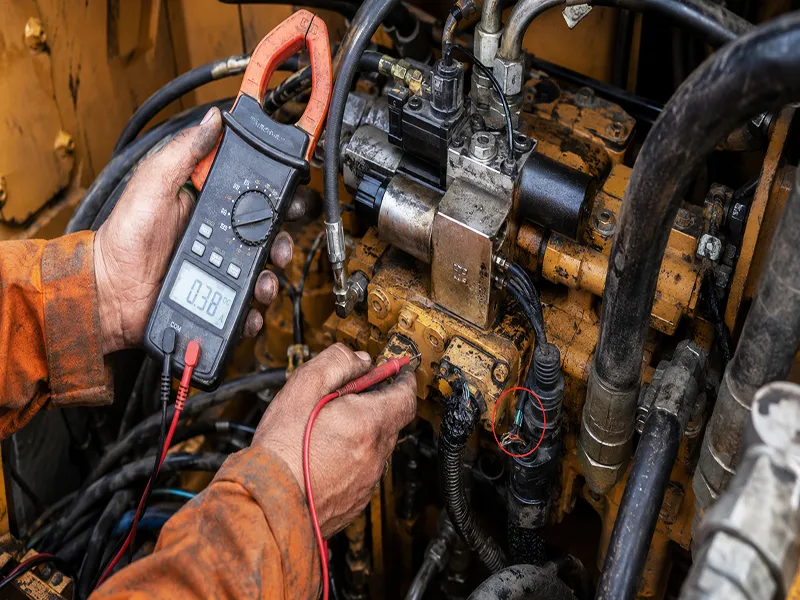
Step 2: Check Proportional Solenoid Current
A DC clamp meter was set to the milliamp range and clamped around one wire of the proportional solenoid valve.
The machine was switched to heavy-load mode, the engine was started, and hydraulic functions were operated.
The meter showed: No current reading.
This indicated that the proportional solenoid valve was not receiving normal control current.
Step 3: Check Supply Voltage
The input voltage to the proportional solenoid valve was measured.
Measured voltage: Approximately 24 V
The supply voltage was normal.
This narrowed the fault down to:
- The proportional solenoid coil;
- The solenoid wiring;
- The related control circuit.
Step 4: Check Solenoid Coil Resistance
Resistance across the proportional solenoid terminals was measured.
The result was: ∞ (infinite resistance)
This indicated an open circuit in the solenoid coil circuit.
Further inspection showed that the wire had fatigued and broken at the rubber-sealed wire entry point of the proportional solenoid valve.
Repair:
- Re-solder the broken wires and re-glue and seal them.
- Test the machine again after installing the proportional solenoid valve.
- When operating the work device, the DC clamp meter can already detect the control current that changes with the working conditions.
- DC clamp meter reading: varies between 250~600 mA.
The machine functions normally and the fault is eliminated.
Fault Conclusion
The main hydraulic pump itself was not the cause of the failure.
The actual fault was:
A broken proportional solenoid valve wire caused loss of proportional control, preventing the main pump from adjusting displacement correctly according to engine load.
Therefore, if a CAT 320 shows:
Slow operation + weak digging + severe engine bogging
and pilot pressure is normal, priority should be given to checking:
- Proportional solenoid valve;
- Proportional solenoid coil;
- Controller output wiring;
- Open circuits;
- Short circuits;
- Ground faults;
- Electronic pump power control system.
Case 2 : CAT 320 Operates Slowly and Feels Weak, but the Engine Does Not Bog
Fault Symptoms:
- Slow operation of all hydraulic functions;
- Weak digging performance;
- No obvious engine bogging;
- Very light engine load during hydraulic operation.
This fault condition was clearly different from the first case.
Fault Analysis
For a hydraulic excavator:
1.Operating speed is mainly determined by hydraulic flow.
2.Digging force is mainly determined by hydraulic pressure.
Therefore, when the machine has both:
1.Slow operation + weak digging
2.both pressure and flow must be checked.
Step 1: Check the Proportional Control System and Pilot Circuit
The proportional solenoid valve was checked using the same method as in the first case.
- DC clamp meter reading: 250~600 mA
- Proportional solenoid output pressure: 1.5~3.7 MPa
These results indicated that:
- The proportional control system was functioning;
- The proportional solenoid was responding to operating conditions;
- The pilot hydraulic circuit was basically normal.
Step 2: Check Main Pump Output Pressur
The output pressure of both the upper and lower main hydraulic pumps was measured.
Both were approximately: 26 MPa This was considered too low.
The machine owner explained that the hydraulic system had previously been adjusted and that someone had suspected the main relief valve because the pressure could not be increased sufficiently.
Step 3: Check the Main Relief Valve
The engine was brought up to rated speed and the main relief valve in the main control valve assembly was adjusted.
Even with the adjustment fully turned in, system pressure only increased to:27 MPa,this confirmed that the main relief valve had a problem.
The main relief valve was removed and cleaned. According to the original repair procedure, the internal adjustment was also corrected before reinstalling the valve.
After reassembly and adjustment, the main pump pressure increased to:32 MPa,at this point, digging force returned.
However, the machine still moved very slowly.This indicated that the pressure problem had been corrected, but a flow problem remained.
3. Continue Checking Hydraulic Flow Control
The power regulators for the upper and lower main pumps were adjusted next.
The basic adjustment relationship was:
- Turn the adjustment screw inward: pump power increases.
- Turn the adjustment screw outward: pump power decreases.
Hydraulic power can be simplified as:
Hydraulic Power = Flow × Pressure
Therefore, if pressure remains approximately constant, increasing pump power should increase hydraulic flow and make the machine operate faster.
Adjusting the Pump Power Regulator
First adjustment:Turned inward by 1/4 turn
There was no noticeable change in machine speed.
Second adjustment:Turned inward by another 1/2 turn
Again, there was no noticeable change.
This suggested that the fault was probably not in the pump power regulator itself.
Attention then shifted to the flow control system inside the main control valve.
4. Check the Flow Control Valves in the Main Control Valve
The flow control valves in the main control valve assembly were removed for inspection.
It was found that:The valve spools were packed with paper debris from the hydraulic filter element.
The hydraulic tank and return filter were then inspected.
The return filter had failed and had been torn open in two places.
Filter material had entered the hydraulic system and clogged the flow control valves, severely restricting hydraulic flow.
This was the main reason why the machine continued to operate slowly.
5. Clean the Hydraulic System and Replace the Filter
The following work was carried out immediately:
- Drain the existing hydraulic oil.
- Clean the hydraulic system.
- Replace the damaged hydraulic return filter.
- Clean the flow control valves.
- Remove filter-paper debris from the valve spools.
- Reinstall the flow control valves.
- Refill the system with clean, suitable hydraulic oil.
After restarting and testing the machine:Hydraulic operating speed increased dramatically.
The owner even reported that the machine had never operated that fast since he purchased it.
However, the engine now showed slight bogging.This indicated that hydraulic pump power had become too high and the pump-engine power balance needed to be readjusted.
6. Readjust Main Pump Power
The pump power regulator adjustment screws were gradually backed out.During the adjustment, the following were monitored:
- Overall machine speed;
- Engine speed;
- Engine bogging under high hydraulic load.
Adjustment continued until the machine reached a condition where:
Hydraulic speed was appropriate and the engine no longer bogged.
The machine then returned to normal operating condition.According to the operator, after the repair the machine worked almost like a new excavator.
7. How to Distinguish These Two Fault Conditions
Although both cases exhibited the same symptoms of slow CAT 320 movement and weak digging ability, the engine load performance differed, leading to significantly different directions of the fault.
Case 1: Slow and Weak, With Severe Engine Bogging
If the pilot hydraulic system is normal, priority should be given to checking:
- Proportional solenoid valve;
- Proportional solenoid control circuit;
- Solenoid coil;
- Controller output;
- Main pump power control system.
When the proportional control system fails, the pump may no longer regulate output according to engine load.
If pump power demand continuously exceeds available engine power, engine speed will drop and severe bogging or stalling may occur.
Case 2: Slow and Weak, but Engine Load Feels Light
If the pilot hydraulic system is normal, the main areas to inspect are:
Pressure Control System
- Main relief valve;
- Main pump output pressure;
- Pressure control components.
Flow Control System
- Main pump power regulator;
- Flow control valve;
- Main control valve;
- Hydraulic filter;
- Hydraulic system contamination.
In this situation, the engine is not being heavily loaded, which often means that the hydraulic system is not making full use of available engine power.
8. CAT 320 Hydraulic Troubleshooting Sequence
- Check Engine Condition
- Check Pilot Pressure
- Check the Proportional Solenoid Valve
- Measure Main Pump Pressure
- Check the Main Relief Valve
- Check Hydraulic Flow
- Check for Hydraulic System Contamination
9. Notes on CAT 320 Main Pump Pressure and Flow Adjustment
If, under normal pilot system conditions, slow operation and weak digging occur without engine stalling, first adjust the main overflow pressure, then check the flow rate.
The main pump pressure adjustment range is 30~32 MPa.
However, this may vary depending on the specific CAT 320 model, serial number, hydraulic system version, and testing conditions.
Therefore, in actual maintenance, the data for the corresponding model should be used as the standard; it is not recommended to adjust the system pressure directly based solely on experience. The flow rate can be changed by adjusting the number of shims on the flow regulating valve:
- Increasing shims: Increases flow rate;
- Decreases shims: Decreases flow rate.
If equipped with a hydraulic flow meter, the flow sensor can be connected in series in the single-pump test circuit to test the main pump output flow rate under specified operating conditions.
Conclusion
When a CAT 320 excavator operates slowly and lacks digging power, the fault should not automatically be blamed on the main hydraulic pump.
A key diagnostic clue is whether the engine bogs under hydraulic load.
Slow and Weak With Engine Bogging
Focus on:
Electronic Control → Proportional Solenoid → Pilot Control → Main Pump Power Regulation
Slow and Weak With Light Engine Load
Focus on:
Main Pump Pressure → Main Relief Valve → Main Pump Flow → Power Regulator → Flow Control Valve → Hydraulic System Contamination
A good hydraulic troubleshooting principle is:
Test first, diagnose second; confirm the control system before replacing the hydraulic pump.
Only by evaluating the engine, electronic control system, pilot circuit, main pump pressure, and main pump flow together can CAT 320 hydraulic faults be diagnosed accurately and unnecessary pump replacement or repeated adjustment be avoided.

FarinParts supplies hydraulic pumps, motors, valves, and repair parts for a wide range of excavators and heavy equipment applications. Explore our hydraulic parts to find the right solution for your machine.


