
Hydraulic oil leakage is one of the most common problems found in construction machinery and industrial equipment. A minor leak may initially cause only oil loss or surface contamination, but if it is left unresolved, it can lead to reduced system pressure, slower machine operation, overheating, accelerated component wear, and even potential safety hazards for operators.
Hydraulic leakage generally occurs when hydraulic oil moves beyond the area where it is intended to remain because of pressure differences, excessive clearances, worn components, damaged seals, or loose connections.
Hydraulic leakage can generally be divided into two main types:
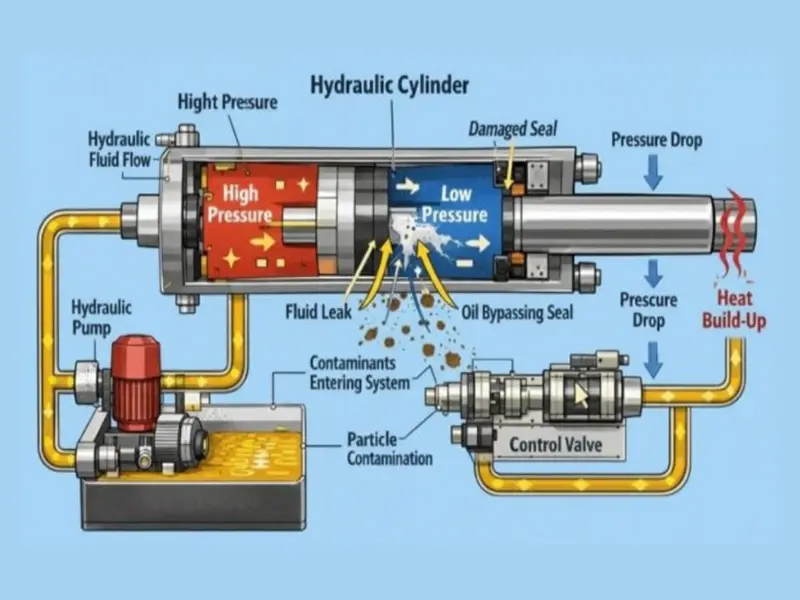
Internal Leakage
Internal leakage occurs when hydraulic oil remains inside the system but passes from a high-pressure area to a lower-pressure area through excessive internal clearances. Common examples include leakage inside hydraulic pumps, cylinders, and control valves.
Because the oil does not escape outside the system, internal leakage is often difficult to see. Typical symptoms may include:
- Slow hydraulic movement
- Weak digging or lifting force
- Cylinder drift
- Reduced hydraulic efficiency
- Excessive oil temperature
- Increased internal pump leakage
External Leakage
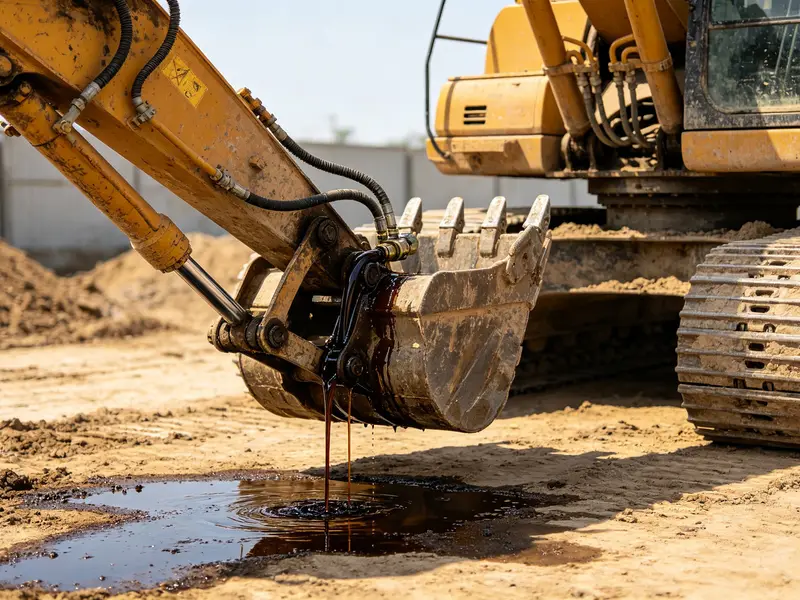
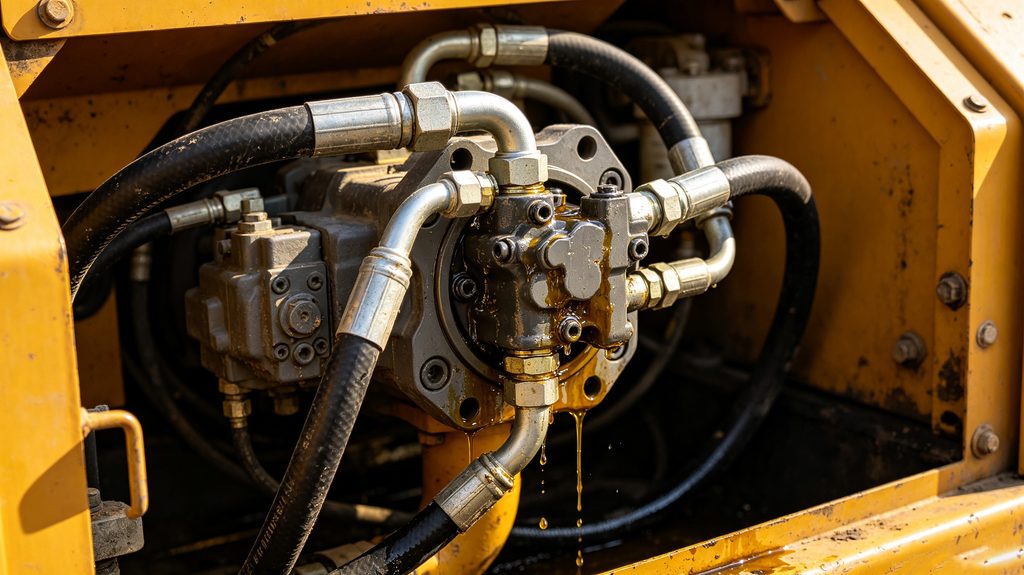
External leakage occurs when hydraulic oil escapes from a hydraulic component or system to the outside environment.
Common leakage points include:
- Hydraulic hoses
- Hose fittings and connectors
- Pump shaft seals
- Valve block joints
- Cylinder rod seals
- Flanges and threaded connections
External leakage is usually easier to identify because oil may appear as seepage, dripping, or spraying around the affected area.
What Causes Hydraulic system oil leakage?
Hydraulic leakage can result from many different conditions, including:
- Worn or hardened seals
- Excessive internal clearances
- Loose fittings
- Damaged hydraulic hoses
- Scratched piston rods
- Worn cylinder bores
- Abnormal system pressure
- Hydraulic oil contamination
- Improper installation
- Incorrect seal selection
- Excessive operating temperature
Because different types of leakage have different causes, replacing a seal or tightening a fitting without identifying the root cause may only provide a temporary solution.
Why Hydraulic system oil leakage Should Not Be Ignored
A leaking hydraulic system can affect much more than oil consumption.
If the problem continues, it may result in:
- Increased hydraulic oil consumption
- Reduced system pressure
- Slower machine response
- Loss of lifting or digging power
- Excessive hydraulic oil temperature
- Accelerated wear of pumps, valves, and cylinders
- Environmental contamination
- Increased downtime and repair costs
- High-pressure oil injection hazards
High-pressure hydraulic oil can penetrate the skin and cause serious injury. Never use your hand to check for a suspected high-pressure leak. Use appropriate diagnostic methods and follow the machine manufacturer’s safety procedures.
Do Not Simply Add More Hydraulic Oil
When a hydraulic system loses oil, repeatedly topping up the tank does not solve the actual problem.
The correct approach is to determine:
- Where is the leakage occurring?
- Is it internal or external leakage?
- What caused the leakage?
- Which component has been damaged?
- Will replacing the seal solve the problem, or does the component also require repair?
For example, replacing a rod seal may not solve a cylinder leak if the piston rod is scratched or the rod guide is excessively worn. Similarly, replacing a hydraulic pump shaft seal may not solve repeated leakage if excessive case pressure is caused by a restricted case-drain line.
FarinParts Hydraulic Repair Tips
At FarinParts, we work with hydraulic pumps, cylinders, valves, seal kits, and related hydraulic components used in excavators and other heavy equipment.
Based on common hydraulic repair and replacement situations, we recommend diagnosing the complete hydraulic system rather than replacing parts based only on visible symptoms.
In this guide, FarinParts will explain:
- Common hydraulic oil leak locations
- How to identify internal and external leakage
- Typical causes of hydraulic leakage
- How to locate the source of a leak
- Hydraulic seal and component repair options
- When replacing seals alone is not enough
- How to prevent recurring hydraulic leaks
- What information to provide when ordering replacement hydraulic parts
Correct diagnosis can help reduce unnecessary component replacement, prevent repeat failures, and minimize machine downtime.
FarinParts recommends looking beyond the visible leak. A durable repair requires identifying the leakage path, the root cause, and the condition of the surrounding components before replacing seals or hydraulic parts.
1. Four Major Hazards of Hydraulic system oil leakage
1.1 Reduced Equipment Efficiency and Higher Energy Loss
Internal or external leakage reduces the amount of hydraulic energy available for useful work. The machine may require more pump output and engine power to perform the same task, while cylinder speed, digging force, lifting performance, and overall hydraulic efficiency decline.
1.2 Reduced Operating Reliability
Persistent leakage can cause unstable pressure, slower response, cylinder drift, overheating, repeated seal failures, and abnormal component loading. Small leaks that are ignored can gradually develop into larger hydraulic faults.
1.3 Product and Environmental Contamination
External hydraulic oil leaks can contaminate the machine, workshop floor, construction site, soil, and surrounding environment. In industries such as food processing, textiles, packaging, and other cleanliness-sensitive applications, leaking hydraulic oil can also contaminate finished products or production areas.
1.4 Contamination Ingress and Accelerated Wear
A failed sealing point can allow dust, water, sand, and other contaminants to enter the hydraulic system. These contaminants can damage hydraulic pumps, control valves, cylinders, bearings, seals, and precision surfaces. The result can become a vicious cycle: seal failure leads to contamination, contamination increases wear, wear increases clearances, and larger clearances create even more leakage.
2. Common Causes of Hydraulic Leakage and How to Prevent Them
Hydraulic sealing performance depends on more than the seal itself. Machining accuracy, surface finish, groove dimensions, alignment, installation practices, operating pressure, fluid cleanliness, and material compatibility all affect sealing reliability.
2.1 Leakage Caused by Poor Machining or Manufacturing Accuracy
Incorrect Seal Groove Depth or Geometry
O-rings and other seals require the correct amount of compression. If a groove is too deep, too shallow, too wide, too narrow, oval, tapered, or out of tolerance, the seal may not be compressed evenly. At low pressure the problem may be difficult to notice, but at higher pressure the insufficient or uneven compression can develop into a serious leak.
If a face-seal groove is too shallow, the O-ring may also be pinched between mating surfaces, partially displaced from the groove, or over-compressed. A pinched section of rubber may initially appear to seal, but can later be extruded by high-pressure oil.
Before assembly, verify groove depth, groove width, shaft or bore diameter, surface condition, concentricity, taper, and the specified seal compression.
Incorrect Threaded-Hole Depth or Bolt Length
A bolt can feel tight even when two mating faces are not fully clamped together. If the threaded hole is too shallow or the bolt is too long, the bolt may bottom out before the flange closes. The resulting loss of clamping force can leave a small sealing gap or allow the O-ring to extrude under pressure.
Check the threaded-hole depth, bolt length, thread engagement, tightening torque, and actual face-to-face contact instead of relying only on the feeling that a bolt is tight.
Positioning Errors Between Pump Bodies, Valve Bodies, and Flanges
Machining or positioning errors can create an offset between hydraulic ports, bolt holes, and O-ring grooves. When a flange is forced into place, the O-ring may no longer sit concentrically around the pressure port. One side may be over-compressed while the opposite side loses effective sealing contact.
During assembly, make sure the bolt holes align naturally, the ports remain centered, the flange is not pulled sideways by the bolts, and the O-ring stays correctly positioned.
Multiple O-Rings on the Same Mating Surface
Valve blocks, pump bodies, and manifold faces may use several O-rings of different diameters on one surface. Leakage can occur when groove depths are inconsistent, O-ring compression varies, mating faces are not parallel, bolt holes are not perpendicular, surface finish is poor, groove edges deform, or seals move during assembly.
Confirm every O-ring size and groove individually. Where appropriate, use a compatible assembly lubricant to help keep the seals in position while the joint is assembled.
Excessive Chamfer Around Sealing Holes
Bonded seals and sealing washers require adequate support around the hole. If the chamfer is too large, the sealing element loses support and can deform or extrude under pressure. Chamfer dimensions should therefore match the sealing arrangement and component drawing.
Rough or Damaged Sealing Surfaces
A rough sealing surface can scratch an O-ring, bonded seal, or rubber sealing lip during tightening. Burrs, tool marks, rust, scratches, and sharp edges can all create a leakage path or shorten seal life.
Before assembly, sealing surfaces should be clean, smooth, flat, free from burrs, and free from damage. Copper sealing washers, where specified by the equipment manufacturer, should generally be treated as single-use items once they have been compressed or visibly deformed.
2.2 Leakage Caused by Improper Installation or Assembly
Hydraulic Pipe Fittings
Pipe fittings are a common source of hydraulic leakage. Correct installation depends on the fitting design, thread type, sealing method, alignment, and tightening torque.
- Threads and tightening nuts must match correctly. Connections that are too loose may not seal, while excessive tightening can damage threads, fittings, or sealing surfaces.
- Fittings should be aligned before tightening. Forcing a tube or hose sideways into position can create continuous side loading, uneven sealing pressure, fatigue, and repeated leakage.
- Use PTFE tape or liquid thread sealant only on connections that are designed to seal through the threads. O-ring face seal, flare, and compression fittings normally seal at a dedicated sealing surface rather than at the thread itself.
- Where thread sealant is appropriate, wrap tape in the tightening direction and avoid excessive layers. Loose fragments can enter the hydraulic system and contaminate precision components.
- Select liquid thread sealants according to hydraulic-fluid compatibility, system pressure, operating temperature, thread material, and cure requirements.
Flared Tube Connections
A flared tube connection requires a smooth, round, crack-free, burr-free flare with the correct angle and concentricity. Poorly formed flares can leak even when the retaining nut is heavily tightened.
Welded Hydraulic Pipe Connections
Welded connections may leak because of incomplete penetration, porosity, cracks, contamination, poor preparation, or welding distortion. After welding, inspect the joint and thoroughly clean the inside of the line to remove slag and metal particles before connecting it to the hydraulic system.
U-Cup Seal Installation
U-cup seals are common in hydraulic cylinders, but the sealing lip can roll, twist, cut, or deform if excessive force is used during installation. Problems may not be visible immediately and can appear only after the system is pressurized.
- Confirm the correct sealing direction.
- Lubricate the seal with compatible hydraulic oil or assembly lubricant.
- Remove burrs and sharp edges from the groove and entry surfaces.
- Use appropriate seal installation tools instead of sharp screwdrivers.
- Confirm that the seal is fully seated and not twisted before final assembly.
Repeated Shaft-Seal Leakage
A leaking shaft seal on a hydraulic pump or motor does not automatically mean the seal itself is defective. Repeated leakage may be caused by a scratched shaft, excessive shaft runout, worn bearings, high case pressure, a restricted case-drain line, excessive temperature, or an incompatible seal material.
Tips: If a new pump shaft seal fails again soon after replacement, check case pressure and the case-drain circuit before installing another seal.
2.3 Leakage Caused by Poor Maintenance or Incorrect Material Selection
Surface Damage to Seals
Seals can be damaged during storage, transport, installation, disassembly, or operation. Cuts, scratches, hardening, deformation, aging, and edge damage can become leakage paths under hydraulic pressure.
Before installing a new seal, inspect the seal groove, piston rod, cylinder bore, gland, and all entry surfaces. A new seal should not be installed into a damaged sealing environment without correcting the underlying problem.
Gap Extrusion, Seal Biting, and Tearing
When a soft seal operates under high pressure with excessive clearance, the material may be forced into the gap between moving components. This can cause extrusion, biting, cutting, tearing, or permanent deformation.
The risk increases with excessive system pressure, worn guide rings or wear rings, incorrect seal hardness, missing backup rings, oversize clearances, or incorrect seal dimensions.
Seal hardness should be selected together with pressure, clearance, temperature, speed, fluid compatibility, and the seal profile. A harder seal may improve extrusion resistance in some applications, but hardness alone is not a universal solution.
O-Ring Twisting
O-rings can twist during installation or reciprocating motion. Common causes include insufficient lubrication, excessive stretching, incorrect groove dimensions, high friction, and rapid assembly. Long-term twisting can create spiral damage, cracks, and premature leakage.
Hydraulic Oil Contamination
Contaminated oil is a major cause of seal and component failure. Metal particles, dust, sand, water, and degraded oil products can damage sealing lips and precision surfaces.
When unusual seal wear is found, inspect not only the seal kit but also the hydraulic oil, filters, tank, cooler, pump, control valve, and other components that may have been exposed to contamination.
Improving Seal Quality and Reliability
Reliable hydraulic sealing requires control of several factors at the same time: material selection, seal geometry, dimensional accuracy, groove design, surface finish, manufacturing process, assembly quality, operating conditions, and maintenance practices.
2.4 Summary of Rapid Diagnosis for Hydraulic System Oil leakage
| Problem | Likely Cause | Recommended Check |
| New O-ring still leaks | Incorrect groove depth, rough surface, misalignment | Measure the groove, inspect surface finish, check port alignment |
| Fitting leaks after tightening | Wrong fitting type, poor alignment, damaged sealing face | Identify fitting standard, realign the line, inspect the sealing surface |
| U-cup leaks soon after rebuild | Rolled or cut sealing lip, wrong installation direction | Inspect seal orientation, entry chamfer, tools, and lubrication |
| Pump shaft seal fails repeatedly | High case pressure, restricted drain, shaft or bearing wear | Measure case pressure and inspect the case-drain line |
| Seal edges are extruded or bitten | Excessive clearance or pressure, missing backup ring | Measure clearance, inspect wear rings, verify seal profile and hardness |
| Several new seals fail quickly | Contamination or damaged metal surfaces | Inspect oil cleanliness, rod/bore condition, filters, and system debris |
3. How to Improve Hydraulic Seal Reliability
Hydraulic seal reliability depends on the complete operating environment. Selecting a seal only by inside diameter and outside diameter is not enough.
3.1 Select the Correct Seal Material
Common hydraulic sealing materials include NBR, HNBR, polyurethane (PU), PTFE, and FKM. Each material has different characteristics for temperature resistance, wear resistance, fluid compatibility, friction, and extrusion resistance.
3.2 Confirm the Correct Seal Profile and Dimensions
Before ordering or installing a seal, confirm the Inner Diameter, Outer Diameter, Height, Groove Width, Groove Depth, and Seal Profile. Two seals with similar diameters may still use completely different profiles and may not be interchangeable.
3.3 Inspect the Surrounding Hardware
A premium seal installed on a scratched piston rod, worn guide, damaged groove, rough shaft, distorted flange, or contaminated component may fail again very quickly. A reliable repair should evaluate the complete sealing environment: Seal + Groove + Rod + Bore + Clearance + Oil Condition.
Safety Note:Never use your hand to search for a suspected high-pressure hydraulic leak. Hydraulic fluid under pressure can penetrate the skin and cause serious injury. Depressurize the system and follow the equipment manufacturer’s safety procedures before inspection or repair.
4. Conclusion: Hydraulic Leakage Is Not Always Just a Seal Problem
Hydraulic oil leakage may look like a simple sealing problem, but the root cause can involve machining accuracy, assembly methods, seal material, worn components, system pressure, excessive clearance, oil contamination, and poor maintenance practices.
If a newly installed seal begins leaking again shortly after repair, do not simply replace the seal kit a second time. Inspect the surrounding component and operating conditions to identify why the original seal failed.
FAQ
1. What are the most common causes of Hydraulic system oil leakage?
Common causes include worn seals, damaged O-rings, loose fittings, cracked hoses, scratched piston rods, poor sealing surfaces, excessive system pressure, incorrect installation, and contaminated hydraulic oil. Internal component wear can also increase leakage inside hydraulic pumps, valves, cylinders, and motors.
2. What is the difference between internal and external hydraulic leakage?
External leakage occurs when hydraulic oil escapes outside the system, such as from a hose, fitting, cylinder rod seal, or pump shaft seal. Internal leakage occurs inside a hydraulic component when oil passes from a high-pressure area to a low-pressure area without leaving the system.
3. How can I find where a hydraulic system is leaking?
Start by cleaning the suspected area and inspecting hoses, fittings, seals, cylinder rods, pump shafts, and valve connections. For internal leakage, pressure testing, flow testing, case-drain testing, or cylinder drift testing may be required. Never use your hand to check for a high-pressure leak.
4. Can a hydraulic system leak without visible oil outside the machine?
Yes. Internal leakage may not produce any visible oil outside the machine. Symptoms may include slow hydraulic movement, weak lifting force, cylinder drift, overheating, or reduced hydraulic efficiency.
5. Why does a hydraulic cylinder still leak after replacing the seal kit?
A new seal kit may fail quickly if the piston rod is scratched, the cylinder bore is damaged, the guide or wear rings are worn, the seal groove is damaged, or the wrong seal size or material was installed. The complete cylinder should be inspected before reassembly.
6. Can high hydraulic pressure cause seal leakage?
Yes. Excessive pressure can cause seals to deform, extrude into clearances, or become damaged. High pressure may result from incorrect relief-valve settings, blocked return lines, restricted case-drain lines, or other hydraulic system faults.
7. Why does a hydraulic pump shaft seal keep leaking?
Repeated shaft-seal leakage may be caused by excessive case pressure, a restricted case-drain line, shaft wear, bearing damage, incorrect seal installation, or an unsuitable seal material. Replacing the shaft seal alone may not solve the root cause.
8. Does contaminated hydraulic oil cause leaks?
Yes. Dirt, metal particles, water, and degraded oil can damage seals and precision hydraulic surfaces. Contamination can accelerate wear in pumps, valves, cylinders, and motors, which increases both internal and external leakage.
9. Should I replace a hydraulic seal as soon as I see a small leak?
A small leak should not be ignored. First identify the source and cause. Replacing the seal may be appropriate, but the surrounding rod, bore, groove, fitting, and system pressure should also be checked to prevent repeat failure.
10. How can hydraulic oil leaks be prevented?
Use the correct seals and fittings, maintain proper system pressure, keep the hydraulic oil clean, replace filters on schedule, inspect hoses and cylinder rods regularly, use correct installation procedures, and repair worn components before they damage new seals.
11. What information should I provide when ordering hydraulic seals or repair parts?
Provide the machine model, serial number, hydraulic component part number, seal or repair-kit number, installation position, dimensions, and clear photos whenever possible. This helps reduce fitment errors.
12. When is replacing seals alone not enough?
Replacing seals alone is usually not enough when there is a scratched or bent rod, worn cylinder bore, damaged groove, excessive mechanical clearance, contaminated oil, high case pressure, or severe internal component wear.


