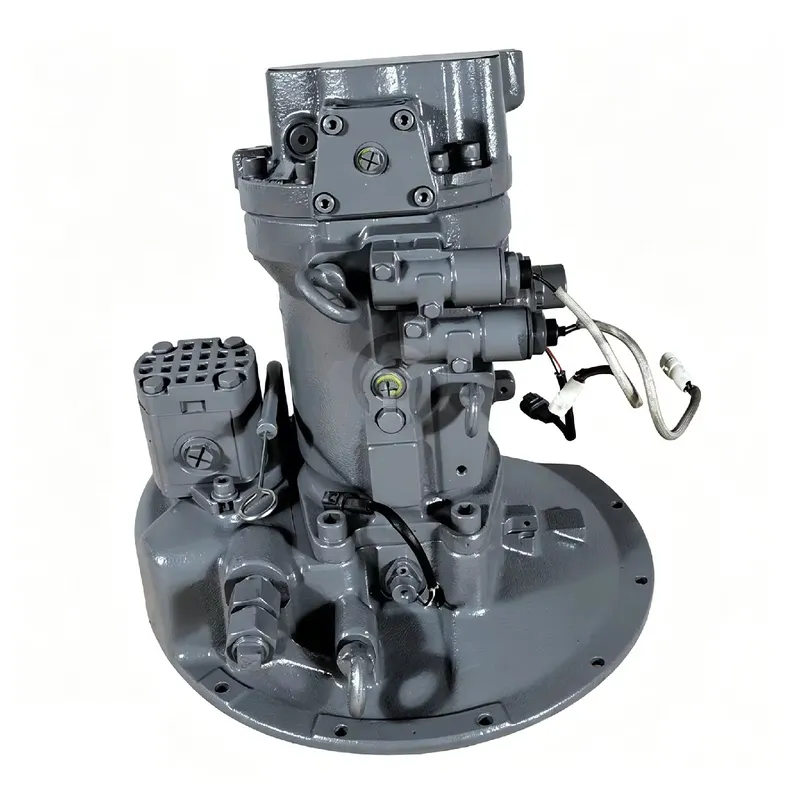


When an excavator is slow and weak, the problem is often related to hydraulic pressure, oil flow, internal leakage, or worn hydraulic components. Slow boom lifting, weak digging force, and poor travel performance are some of the most common symptoms.. In most cases, these symptoms are related to the hydraulic system, but the actual cause may involve the hydraulic pump, main control valve, cylinders, travel motors, pilot system, or even the condition of the hydraulic oil.
Replacing the hydraulic pump or cylinder without proper diagnosis can be expensive and may not solve the real problem.
This guide focuses on two common excavator problems:
- Slow and weak boom operation
- Weak or slow travel on one side
It also explains the possible causes and practical troubleshooting methods.
1.Symptoms of a Slow and Weak Excavator Boom
If you are troubleshooting an excavator slow and weak boom, first determine whether the problem affects only the boom or several hydraulic functions.
A typical symptom is:
The excavator boom lifts very slowly and lacks power during operation, while the bucket, arm, swing, and travel functions remain relatively normal.
If only the boom is affected while other hydraulic functions operate normally, the problem is more likely to be related to the boom hydraulic circuit, boom control valve, or boom cylinder, rather than the entire hydraulic pump system.
Other possible symptoms include:
- The boom lifts much more slowly than before.
- The boom cannot lift properly under load.
- Boom operation is acceptable without a load but becomes weak under load.
- The boom slowly drops after being raised.
- The problem becomes worse as the hydraulic oil temperature increases.
- The boom moves with hesitation, jerking, or delayed response.
2. Why Is an Excavator Slow and Weak?Analysis of Common Causes
An excavator slow and weak condition can result from low hydraulic pressure, insufficient pump flow, internal leakage, contaminated hydraulic oil, or problems with the main control valve.
2.1 Restricted or Blocked Hydraulic Oil Passage
Contamination, metal particles, or damaged seal fragments can enter the hydraulic system and restrict oil flow.
Possible restrictions include:
- Blocked valve passages
- Clogged orifices
- Clogged hydraulic filters
- Restricted hydraulic hoses or pipes
- Contamination inside the main control valve
When insufficient hydraulic oil reaches the boom cylinder, the boom may move slowly and lose lifting power.
2.2 External Hydraulic Leakage
External leakage can reduce available hydraulic pressure and flow.
Common leakage points include:
- Hydraulic hose fittings
- High-pressure hoses
- O-rings
- Flange seals
- Main control valve connections
- Cylinder ports
Common causes include:
- Worn seals
- Damaged O-rings
- Loose fittings
- Damaged sealing surfaces
- Incorrect installation
If the leakage is severe enough, the hydraulic system may not be able to build sufficient pressure, resulting in weak boom operation.
2.3 Internal Leakage or Sticking of the Boom Control Valve
The boom spool inside the main control valve controls the flow of hydraulic oil to and from the boom cylinder.
Problems may include:
- Worn spool
- Worn valve bore
- Sticking spool
- Internal valve leakage
- Blocked internal oil passages
Any of these problems can reduce the pressure or flow reaching the boom cylinder.
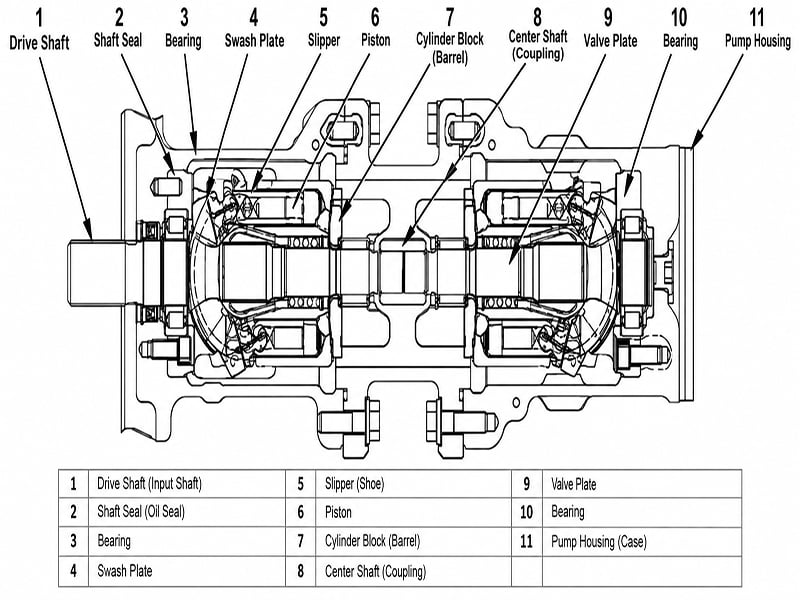
If only the boom function is affected while other hydraulic functions remain normal, the boom spool should be one of the main components to inspect.
2.4 Internal Leakage in the Boom Cylinder
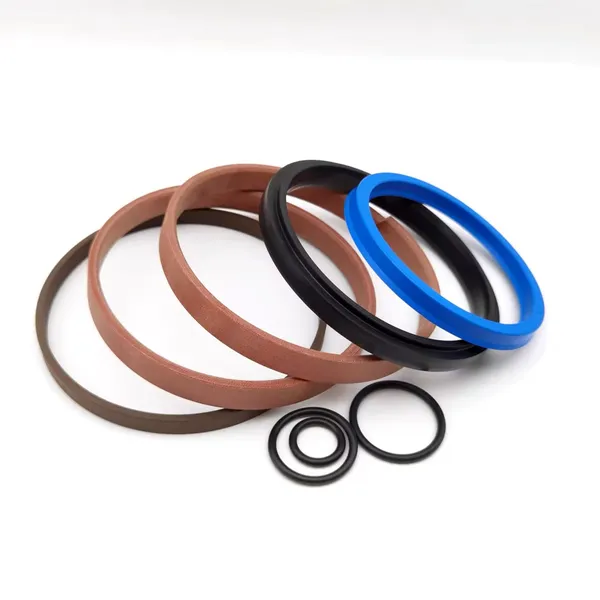
The piston seals inside the hydraulic cylinder separate the rod side from the head side of the cylinder.
When the piston seals become worn or damaged, high-pressure hydraulic oil can bypass the piston internally.
Typical symptoms include:
- Weak boom lifting
- Slow boom movement
- Boom drifting downward under load
- Symptoms becoming worse as hydraulic oil temperature rises
Internal cylinder leakage may not produce visible external oil leakage, which makes it easy to overlook.
2.5 Contaminated Hydraulic Oil or Excessive Oil Temperature
Hydraulic oil condition has a major effect on excavator performance.
Problems may occur if the hydraulic oil is:
- Contaminated
- Emulsified with water
- Too thin due to high temperature
- Severely degraded
- Overheating during operation
When oil viscosity decreases, internal leakage inside hydraulic pumps, valves, and cylinders may increase.
A common symptom is:The excavator works relatively normally when cold but becomes slower and weaker after the hydraulic oil warms up.
If the excavator slow and weak symptoms become more noticeable after the hydraulic oil reaches operating temperature, excessive internal leakage should be investigated.
3.How to Troubleshoot Excavator Slow and Weak Boom
The best approach is to diagnose the problem from simple checks to more complex inspections, and from external components to internal components.
This can help prevent unnecessary disassembly of the hydraulic pump or main control valve.
Step 1: Check the Hydraulic Oil and Filters
Start by checking:
- Hydraulic oil level
- Oil color and condition
- Signs of water contamination or emulsification
- Metal particles or other contaminants
- Return filter condition
- Suction strainer condition
If a large amount of metal debris is found, further inspection may be required to determine whether the hydraulic pump, motor, or other hydraulic components are wearing internally.
Step 2: Check for External Hydraulic Leaks
Inspect the following areas carefully:
- Boom cylinder
- High-pressure hoses
- Hose and pipe connections
- Main control valve
- Flange connections
Loose fittings and damaged seals should be repaired before moving on to more complicated troubleshooting.
Step 3: Measure Hydraulic System Pressure
Use a suitable hydraulic pressure gauge to measure system pressure while operating the boom.
Compare:
- Boom lifting pressure
- Pressure of other hydraulic functions
- Main pump output pressure
- Manufacturer’s specified pressure values
If the pressure of other functions is normal but the boom circuit pressure is abnormal, the problem is more likely to be located in the:Boom control valve, boom cylinder, or boom hydraulic circuit.
Step 4: Inspect the Boom Control Spool
If a blocked oil passage or sticking valve spool is suspected, the boom control section of the main valve may need to be inspected.
Check for:
- Smooth spool movement
- Scratches or scoring
- Foreign material or contamination
- Blocked oil passages
- Excessive wear inside the valve body
Hydraulic components must be cleaned in a clean environment to prevent new contamination from entering the system.
If boom operation returns to normal after cleaning, contamination or spool sticking was likely the cause.
4.How to Check a Boom Cylinder for Internal Leakage
Internal leakage inside the boom cylinder is a common cause of weak lifting performance and is often misdiagnosed.
One method is to perform a cylinder leakage test.
With the machine safely positioned and according to the manufacturer’s service procedure, the cylinder can be moved to the specified position and hydraulic pressure applied to one side.
The opposite oil chamber can then be checked for abnormal oil flow.
If hydraulic oil continuously flows from the chamber that should be isolated by the piston seals, this may indicate:
Internal leakage past the piston seals.
The cylinder may then need to be disassembled and inspected.
Components that should be checked include:
- Piston seals
- Wear rings
- Piston rod
- Cylinder barrel
- O-rings
- Dust seals
- Buffer seals
If only the seals are replaced without checking the piston rod and cylinder barrel for scratches or scoring, the new seals may fail again quickly.
5.Symptoms of Weak Travel on One Side of an Excavator
One track operates normally while the other track moves slowly or lacks power.
Typical symptoms include:
- Left track operates normally while the right track is weak.
- Right track operates normally while the left track is slow.
- The excavator pulls to one side while traveling straight.
- One track loses power when climbing a slope.
- Travel speed differs noticeably between the two sides.
These symptoms usually indicate a difference between the left and right hydraulic travel circuits.
6. Common Causes of Weak Travel on One Side
6.1 Low Output or Damage to One Hydraulic Pump
A worn main hydraulic pump is one possible cause of an excavator slow and weak condition, especially when several functions become slow at the same time.
Many excavators use a dual-pump hydraulic system.
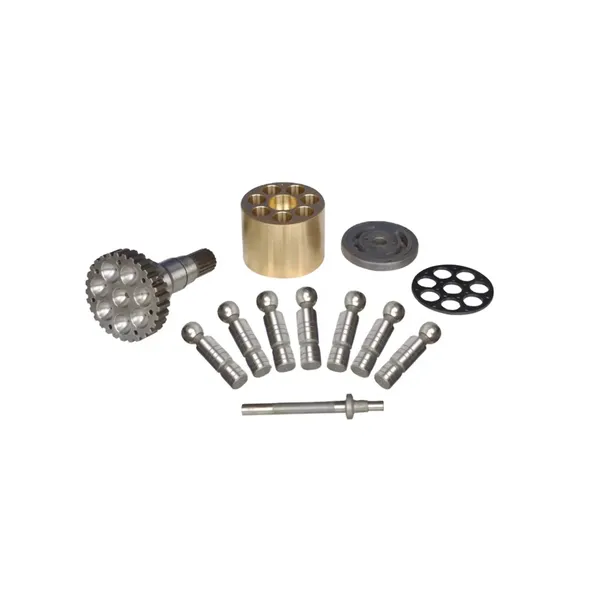
If one pump develops problems such as:
- Worn piston shoe
- Worn valve plate
- Regulator malfunction
- Excessive internal leakage
the corresponding travel circuit may receive insufficient hydraulic pressure or flow.
6.2 Internal Leakage in the Center Joint
The upper structure of an excavator rotates continuously, so hydraulic oil for the travel motors must pass through the center joint, also known as the swivel joint.
When the internal seals become worn, high-pressure oil may leak internally between passages.
Typical symptoms include:
- Weak travel on one side
- Unequal left and right travel speed
- Excavator pulling to one side
6.3 Internal Leakage in the Travel Motor
If the pistons, cylinder block, or valve plate inside the travel motor become worn, internal leakage may increase.
As a result, hydraulic oil cannot be converted efficiently into travel torque.
Possible symptoms include:
- Slow travel speed
- Weak travel power
- Reduced climbing ability
6.4 Sticking Travel Motor Counterbalance Valve
Travel motors are normally equipped with a counterbalance valve or braking control valve.
If the valve spool becomes:
- Stuck
- Worn
- Contaminated
hydraulic oil flow may be restricted, causing weak travel on one side.
6.5 Insufficient Pilot Pressure
Pilot pressure is used to shift the main control valve spools.
If one side has:
- Worn travel pedal valve
- Blocked pilot oil passage
- Insufficient pilot pressure
- Restricted return oil flow
the corresponding travel spool may not open fully, causing reduced travel performance.
6.6 Travel Spool Problems in the Main Control Valve
The travel spool inside the main control valve may also cause single-side travel weakness if it develops:
- Sticking
- Wear
- Internal leakage
- Contamination
7. How to Troubleshoot Weak Travel on One Side?
Step 1: Check Hydraulic Oil Temperature
First compare machine performance when the hydraulic oil is cold and when it is fully warmed up.
If:travel is relatively normal when cold but becomes weak when hot,
excessive internal leakage in the hydraulic pump, travel motor, or main control valve should be considered.
Step 2: Check the Travel Motor for Abnormal Noise
Operate the machine at low travel speed and compare both travel motors.
Check for differences in:
- Noise
- Vibration
- Operating temperature
- Smoothness of movement
If the weak-side travel motor runs noticeably hotter or produces abnormal noise, further inspection is recommended.
Step 3: Compare Travel Motor Case Drain Flow
The case drain flow of the left and right travel motors can be compared.
Under similar operating conditions, the leakage volume of both motors should normally be relatively close.
If one travel motor has significantly higher case drain flow than the other, that motor may have excessive internal wear or leakage.
This is a very useful diagnostic method for identifying a worn travel motor.
Step 4: Measure Front and Rear Pump Pressure
Measure and compare:
- Front pump pressure
- Rear pump pressure
- No-load pressure
- Loaded operating pressure
Compare the readings with the specifications in the service manual.
If one pump produces noticeably lower pressure or flow than the other, the pump and its control system should be inspected further.
Step 5: Inspect the Center Joint
If the hydraulic pumps and travel motors are operating normally, inspect the center swivel joint.
On older excavators, worn internal seals inside the center joint are a relatively common cause of single-side travel weakness.
8.Recommended Troubleshooting Sequence for Excavator Slow and Weak
When diagnosing slow or weak excavator operation, the following sequence can help narrow down the fault efficiently.
Excavator slow and weak troubleshooting checklist:
Hydraulic oil level and condition
↓
Hydraulic filters
↓
Hydraulic hoses and external leakage
↓
Pilot pressure
↓
Main hydraulic system pressure
↓
Main control valve spools
↓
Hydraulic cylinder internal leakage
↓
Travel motor case drain flow
↓
Center swivel joint
↓
Main hydraulic pump
Following this sequence is usually more efficient than immediately disassembling or replacing the main hydraulic pump.
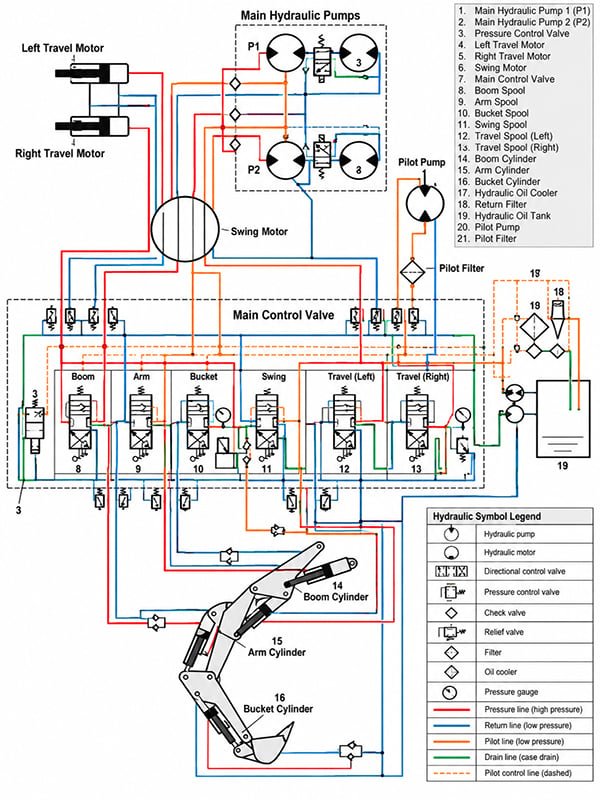
9.Do Not Ignore Hydraulic System Contamination
Many hydraulic problems are not caused by one component suddenly failing.
Instead, contamination may gradually damage the hydraulic system over time.
For example:
Contaminated hydraulic oil → valve spool wear → increased internal leakage → higher oil temperature → reduced hydraulic efficiency → slower machine operation
After repairing or replacing hydraulic pumps, main control valves, hydraulic cylinders, or travel motors, it is also important to:
- Clean the hydraulic tank
- Inspect or replace the hydraulic oil
- Replace contaminated filters
- Inspect hydraulic hoses for contamination
- Flush affected hydraulic circuits when necessary
Otherwise, contaminated oil can quickly damage newly installed hydraulic components.
10.Conclusion
When diagnosing an excavator slow and weak problem, do not replace the hydraulic pump or other expensive components based on symptoms alone.
If:only the Boom Is Slow and Weak
Check the following first:
Boom hydraulic circuit → Boom control spool → Boom cylinder → Pilot system
Only One Side of the Excavator Has Weak Travel
Check:
Travel motor → Pilot pressure → Main control valve → Center joint → Corresponding hydraulic pump
If multiple excavator functions become slow and weak at the same time, the diagnosis should also include:
Main hydraulic pump, main relief valve, engine speed, and overall hydraulic system pressure and flow.
Accurate hydraulic troubleshooting should combine pressure testing, flow testing, case drain testing, hydraulic oil inspection, and actual machine symptoms.
This helps identify the real cause of the problem and reduces unnecessary parts replacement and repair costs.
Safety Note: Excavator hydraulic systems operate under extremely high pressure. Before disconnecting hydraulic hoses, valves, or cylinders, fully release the hydraulic system pressure and lower or securely support the boom and attachment. Always follow the service manual for the specific excavator model when checking pressure values, test ports, or disassembly procedures.
FAQ
1.Why is my excavator slow and weak?
If your excavator is slow and weak, common causes include low hydraulic pressure, restricted oil flow, a worn hydraulic pump, internal leakage, or a sticking control valve.
An excavator may become slow and weak because of low hydraulic pressure, restricted oil flow, contaminated hydraulic oil, internal leakage, a worn hydraulic pump, a sticking control valve, or leakage inside a cylinder or travel motor. The exact cause depends on whether one function or multiple functions are affected.
2.Why is only the excavator boom slow and weak?
If the boom is slow and weak while the bucket, arm, swing, and travel functions work normally, the problem is more likely related to the boom circuit. Common causes include a sticking boom spool, restricted hydraulic passages, internal leakage in the boom cylinder, or insufficient pilot pressure.
3.Why does my excavator lose power when the hydraulic oil gets hot?
If the machine works normally when cold but becomes weak after warming up, excessive internal leakage may be the cause. Worn pumps, valves, cylinders, or travel motors can leak more as the hydraulic oil becomes thinner at higher temperatures.
4.What causes an excavator to travel weakly on one side?
Weak travel on one side may be caused by a worn travel motor, excessive case drain, low pilot pressure, a sticking travel spool, internal leakage in the center joint, or low output from one section of the main hydraulic pump.
5.Should I replace the hydraulic pump if my excavator is slow?
Not necessarily. A slow excavator does not always mean the hydraulic pump is bad. Before replacing the pump, check the hydraulic oil, filters, pilot pressure, system pressure, control valves, cylinders, travel motors, and center joint. Proper testing can prevent unnecessary parts replacement.