


After a fuel injector has been disassembled, cleaned, repaired, had parts replaced, or been reassembled, its condition cannot be judged by appearance alone. A fuel injector leak test is an important inspection after repair. It is used to determine whether the injector has fuel leakage, abnormal pressure retention, or poor nozzle sealing under specified pressure conditions.
This is especially important for diesel common rail injectors. Under high pressure, even very small sealing problems may cause hard starting, unstable idle, abnormal return flow, or poor injection performance.
Therefore, before reinstalling a repaired injector on the engine, appropriate testing should be performed according to the injector type and manufacturer’s specifications.
Why Is a Fuel Injector Leak Test Necessary After Repair?
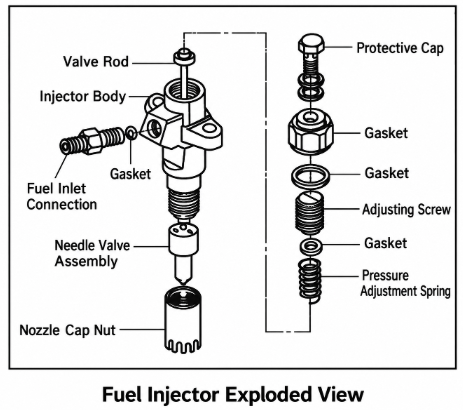
A fuel injector contains a needle valve, valve seat, control valve, seals, and multiple precision components.
During disassembly and repair, leakage may occur due to:
- Wear or scratches on the needle valve or valve seat
- Poor control valve sealing
- Damaged O-rings or other seals
- Misaligned or twisted seals
- Contamination inside the injector
- Incorrectly installed connections
- Precision components worn beyond allowable limits
Some problems may not be obvious at low pressure but become noticeable as test pressure increases.
Therefore, professional injector repair should not only check whether the injector can spray normally. It should also check its sealing performance, return flow, injection quantity, and spray pattern.
What Is Needed Before a Fuel Injector Leak Test?
Depending on the injector type, the following equipment is generally required:
- Fuel Injector Test Bench
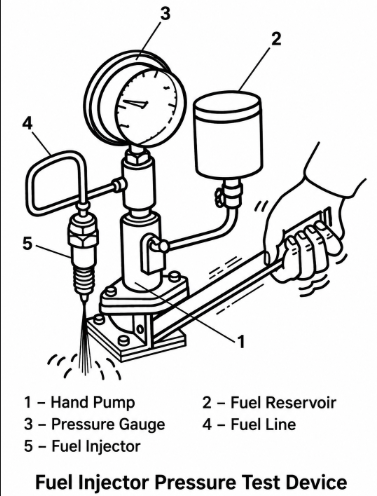
- Pressure testing equipment
- Pressure gauge or electronic pressure sensor
- High- and low-pressure connecting lines
- Appropriate connectors and adapters
- Test oil or manufacturer-specified test fluid
- Transparent measuring cup or measuring container
- Safety glasses and other protective equipment
For modern diesel common rail injectors, a professional test bench is recommended. Their operating pressure is much higher than that of traditional mechanical injectors or conventional gasoline injectors, and ordinary manual pressure equipment usually cannot fully simulate actual operating conditions.
Pre-Test Inspection
Before beginning the test, make sure the injector has been assembled correctly, the seals are properly positioned, all connections are secure, and there is no significant air inside the test lines.
If the nozzle, control valve, seals, or other internal components were replaced during repair, make sure the replacement parts are fully compatible with the injector.
Static Fuel Injector Leak Test
A static leak test is mainly used to determine whether the injector can maintain a proper seal when it is not injecting fuel.
Basic Test Procedure
Install the injector correctly on the test equipment and keep the injector in the closed position.
Gradually build pressure according to the specified test procedure for that injector and maintain the pressure for the required period.
During the test, check:
- Whether system pressure drops abnormally
- Whether fuel drips from the nozzle tip
- Whether the high-pressure connection leaks
- Whether external leakage appears around the injector body
- Whether return flow is abnormal
Under normal conditions, the nozzle should remain securely closed when the injector does not receive an opening signal.
If fuel droplets continuously form at the nozzle, the needle valve, valve seat, and control system should be inspected further.
Note: Allowable pressure drop, holding time, and leakage limits vary between injector models. They should be evaluated according to the test specifications for the specific injector.
Dynamic Leak and Injection Test
After the static fuel injector leak test, the injector should be tested under simulated operating conditions.
A professional injector test bench can operate the injector according to:
Rail Pressure → Injection Pulse → Injection Frequency → Injection Quantity
Several areas should be checked during the test:
During Injection
Check whether the spray is uniform and whether there is obvious spray deviation, an abnormal fuel stream, or large fuel droplets.
After Injection Stops
Check whether fuel continues to seep or drip from the nozzle after it closes.
Pressure Stability
Check for abnormal pressure changes while the injector is operating.
Return Flow
Check whether the injector’s return flow is within its specified range.
For a common rail injector, return flow testing is particularly important. Excessive return flow may be associated with wear of the control valve, needle valve, or other internal precision surfaces.
Is a Vacuum Leak Test Necessary?
Some fuel injector repair equipment can also perform a vacuum leak test.
This method is mainly used to detect very small internal sealing problems.
The test equipment creates a vacuum at the specified location and then monitors:
- Vacuum retention
- Pressure changes
- Continuous leakage
The specific vacuum level and holding time should be set according to the test equipment or injector manufacturer’s specifications rather than using the same parameters for every injector.
A vacuum test can support a fuel injector leak test, but it cannot completely replace dynamic testing and injection performance testing under the specified pressure.
Common Leak Points Found During a Fuel Injector Leak Test
Nozzle Needle and Valve Seat Leakage
This is a common location for internal injector leakage.
Possible causes include:
- Needle valve wear
- Valve seat wear
- Surface scratches
- Contamination of precision mating surfaces
- Carbon deposits that have not been completely removed
- Damaged nozzle components
If a precision sealing surface has worn beyond its allowable limit, the appropriate component should be replaced according to the repair procedure rather than being ground or polished arbitrarily.
This is especially important for modern high-pressure common rail nozzles because their mating tolerances are extremely small. Incorrect grinding may further affect injection performance.
O-Ring or Seal Leakage
Common causes include:
- Twisted O-rings
- Incorrect installation position
- Aged seals
- Seals damaged by installation tools
- Incorrect seal size or material
Replacement seals should match the specifications of the original injector.
High-Pressure Connection Leakage
If fuel leakage occurs at the injector’s high-pressure connection, check:
- Whether the contact surface is damaged
- Whether contamination is present
- Whether the high-pressure line is deformed
- Whether the connection is installed correctly
- Whether the tightening procedure meets manufacturer requirements
Do not attempt to solve leakage simply by applying excessive tightening torque, as this may damage the injector or high-pressure line sealing surfaces.
Internal Control Valve Leakage
In some Bosch, Delphi, and Denso Common Rail Injectors, the sealing condition of the control valve directly affects injector operation.
If the control valve is worn, the following may occur:
Internal Leakage ↑ → Return Flow ↑ → Injector Performance ↓
Possible symptoms include excessive return flow, difficulty building rail pressure, hard starting, or abnormal injection quantity.
What Should Be Checked After the Fuel Injector Leak Test?
An injector is not necessarily fully qualified simply because there is no visible fuel leakage.
Depending on the injector model, a complete injector test may also include:
| Test | Main Purpose |
|---|---|
| Leak Test | Check internal and external leakage |
| Return Flow Test | Check fuel return quantity |
| Injection Quantity Test | Check injection quantity |
| Spray Pattern Test | Check spray pattern |
| Opening/Response Test | Check injector response |
| Electrical Test | Check solenoid or piezoelectric components |
| Calibration Test | Check injection calibration data |
For injectors requiring an IMA/IQA/Correction Code, new correction data may also need to be generated by the test equipment after repair and calibration.
After installation on the vehicle, Fuel Injector Coding should then be completed according to the requirements of the engine and ECU.
Fuel Injector Leak Test Safety Precautions
Diesel common rail systems can operate at extremely high pressures. Never use your hands to check the nozzle or high-pressure connections for leakage during testing.
A high-pressure fuel jet can penetrate the skin and cause serious injury.
During testing:
- Use appropriate professional testing equipment
- Wear safety glasses and necessary protective equipment
- Keep your body away from the injector spray direction
- Never touch pressurized lines to locate a leak
- Make sure high-pressure lines and connections are secure
- Keep the work area properly ventilated
- Remove air from the test lines before testing
- Set pressure according to the test procedure for the specific injector
For common rail injectors in particular, an unverified homemade high-pressure device should not be used to simulate full operating pressure.
Why Do Fuel Injector Test Parameters Vary?
Gasoline port injection, gasoline direct injection, traditional mechanical diesel injectors, and modern diesel common rail injectors operate differently and use very different pressure ranges.
Even among Bosch Common Rail Injectors, different series may have completely different:
Test Pressure → Injection Quantity → Return Flow → Pulse Width → Leakage Limit
Therefore, an injector should not be judged using a single universal pressure value.
For an accurate fuel injector leak test, the correct testing conditions and acceptance limits should be determined according to:
Injector Part Number → Application → Test Plan → Manufacturer/Test Bench Data
Conclusion
After a fuel injector has been disassembled, cleaned, and repaired, a fuel injector leak test is an important step before the injector is returned to service.
A static leak test primarily checks for leakage while the injector is closed. A dynamic test further simulates actual operating conditions to evaluate injection, pressure retention, return flow, and nozzle sealing.
For modern common rail injectors, confirming that the nozzle does not drip is not enough. Return flow, injection quantity, spray pattern, and calibration data should also be considered when determining whether the injector meets operating requirements.
If suitable high-pressure testing equipment is not available, the injector should be tested by a repair facility equipped with a professional fuel injector test bench rather than attempting high-pressure injection testing without appropriate equipment.
FAQ
What is a Fuel Injector Leak Test?
A injector leak test checks whether a fuel injector can maintain proper sealing under specified pressure conditions. It helps identify nozzle leakage, internal leakage, abnormal return flow, and leakage at high-pressure connections.
Why should a fuel injector be leak tested after repair?
Disassembly, cleaning, parts replacement, and reassembly can affect the injector’s sealing performance. Testing after repair helps confirm that the needle valve, control valve, seals, and other precision components are working correctly before the injector is reinstalled.
What are the signs of a leaking fuel injector?
Possible signs include fuel dripping from the nozzle, excessive return flow, difficulty building rail pressure, hard starting, unstable idle, and abnormal injection performance. The exact symptoms depend on the injector type and location of the leakage.
Is a static leak test enough for a common rail injector?
No. A static leak test checks sealing while the injector is closed, but a common rail injector should also be evaluated under simulated operating conditions. Dynamic testing can check injection quantity, return flow, spray pattern, pressure stability, and nozzle sealing.
Can I perform a Fuel Injector Leak Test without a professional test bench?
For modern common rail injectors, a professional fuel injector test bench is recommended because these systems operate at extremely high pressures. An unverified homemade high-pressure testing device should not be used to simulate full operating pressure.


