


A hydraulic breaker is one of the common attachments used on excavators in mining, quarrying, road construction, building demolition, and other applications.
Proper hydraulic breaker nitrogen pressure is essential for maintaining stable impact force and normal breaker performance.
When this happens, in addition to checking the hydraulic system, piston, control valve, and seals, hydraulic breaker nitrogen pressure is also an important item to inspect.
Why Does a Hydraulic Breaker Need Nitrogen?
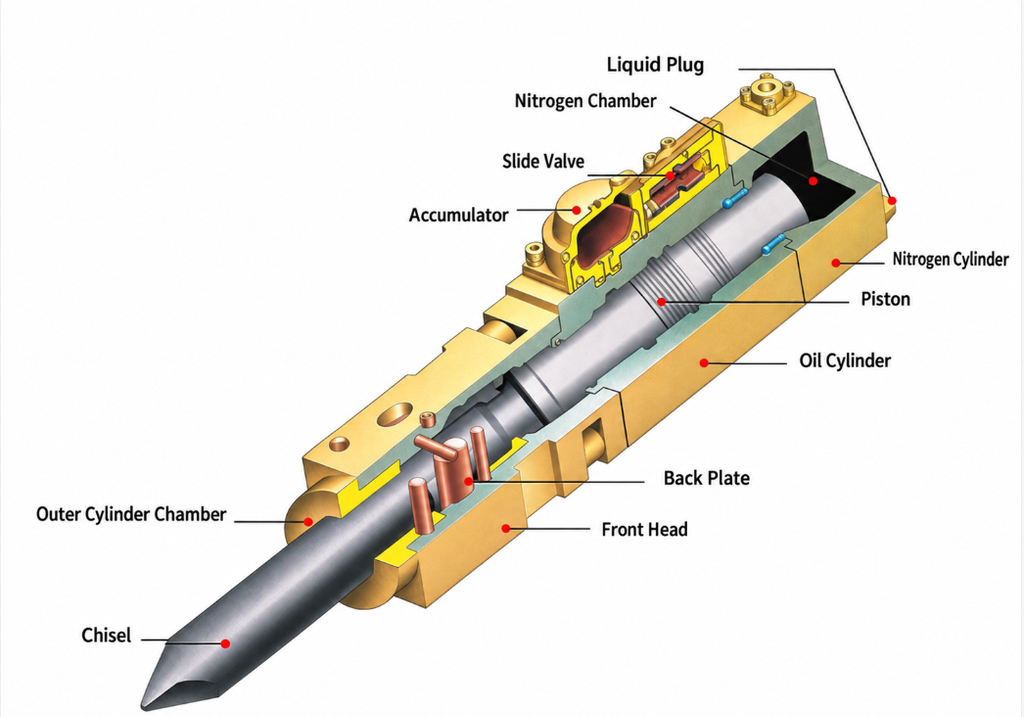
Hydraulic breaker nitrogen helps store and release energy during repeated impact cycles.Nitrogen has good stability and is mainly used in hydraulic breakers to store and release energy while assisting the hydraulic system in completing the piston’s high-speed impact movement.
In some hydraulic-gas combination breakers, nitrogen is mainly used in two areas:
- Back Head (rear head / upper nitrogen chamber)
- Accumulator
Although both use nitrogen, their functions are not exactly the same.
Nitrogen in the Back Head
The nitrogen in the back head is located behind the piston.
When the piston moves upward, the nitrogen is compressed and stores energy. When the piston enters the impact stroke, the compressed nitrogen expands and works together with the hydraulic oil to push the piston downward.
Therefore, it can help increase the piston’s impact energy.
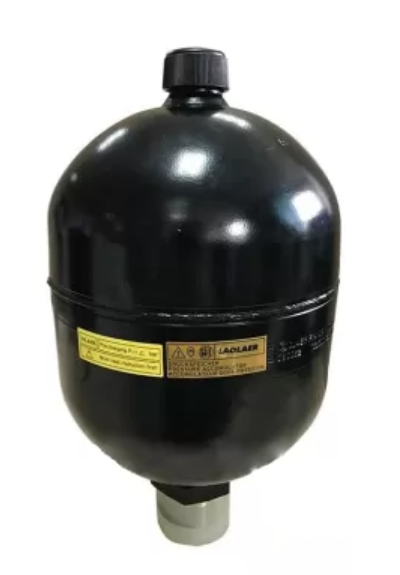
Nitrogen in the Accumulator
The accumulator uses the compressibility of nitrogen to store hydraulic energy.
During breaker operation, hydraulic pressure and flow change rapidly. The accumulator can absorb part of the energy when pressure rises and release it during the next impact cycle, helping to:
- Stabilize hydraulic pressure
- Compensate for instantaneous flow demand
- Reduce hydraulic shock
- Improve impact stability
- Protect the hydraulic system
Simply put:
Nitrogen acts like a “spring” and an “energy buffer” in the hydraulic breaker system.
Why Is Nitrogen Used in Hydraulic Breakers?
Hydraulic breakers generally use nitrogen instead of ordinary air or other gases.
The main reasons include:
Stable Chemical Properties
Nitrogen is a relatively inert gas and does not easily react with hydraulic oil, rubber seals, or metal components under normal operating conditions.
Stable Compression Performance
Nitrogen can be repeatedly compressed and expanded inside the accumulator and back head, allowing relatively stable energy storage and release.
Reduced Oxidation
Ordinary air contains oxygen and moisture.
Under long-term high-temperature and high-pressure conditions, moisture and oxygen may accelerate:
- Hydraulic oil oxidation
- Metal corrosion
- Seal material aging
What Is the Relationship Between Nitrogen and Hydraulic Breaker Impact Force?
When the breaker operates, the hydraulic system drives the piston at high speed.
For breakers that use both hydraulic power and nitrogen, nitrogen pressure directly affects the piston’s operating condition.
How Much Nitrogen Should Be Added to a Hydraulic Breaker?
More nitrogen does not necessarily mean better performance. The specified nitrogen pre-charge pressure may vary depending on the brand, model, and size of the hydraulic breaker.
The more nitrogen that is added, the higher the pressure inside the accumulator. However, the optimum accumulator pressure may vary slightly depending on the breaker specification, model, and external climate conditions.
Before charging, always check the nitrogen pressure specified in the Manufacturer Service Manual.
What Happens If the Hydraulic Breaker Nitrogen Pressure Is Too Low?
If insufficient nitrogen is added, the pressure inside the accumulator will not reach the required level, which may cause weak breaker impact.
It may also damage an important accumulator component, the diaphragm.
If the diaphragm is damaged, repair may require complete disassembly, which is relatively complicated and costly.
Therefore, when charging nitrogen, it is important to ensure that the pressure reaches the required value.
What Happens If Too Much Nitrogen Is Added?
Since insufficient nitrogen affects breaker performance, does that mean the more nitrogen added, the better?
The answer is no.
If too much nitrogen is added, the pressure inside the accumulator becomes too high. If the hydraulic oil pressure is not sufficient to push the cylinder rod upward and compress the nitrogen, the accumulator will not be able to store energy, and the breaker may fail to operate.
Therefore, both excessive and insufficient nitrogen can prevent the hydraulic breaker from working properly.
When charging nitrogen, always use a pressure gauge to measure the pressure and keep the accumulator pressure within the normal range. Minor adjustments may be made according to actual operating conditions. This helps protect components while maintaining good operating efficiency.
When Should Hydraulic Breaker Nitrogen Pressure Be Checked?
Nitrogen pressure should be checked if the hydraulic breaker shows any of the following conditions:
- Impact force decreases significantly
- Impact frequency changes
- Breaking efficiency decreases
- Accumulator operates abnormally
- The accumulator diaphragm has just been replaced
- The hydraulic breaker has undergone a major overhaul
- The breaker is being used again after long-term storage
- Nitrogen leakage is suspected
For continuous heavy-duty applications such as mining and quarrying, the inspection frequency should be increased appropriately.
How to Charge Nitrogen into a Hydraulic Breaker
Different brands and models may have different nitrogen charging structures, but the basic operating procedure is similar.
Step 1: Prepare the Tools
Usually required:
- Nitrogen Cylinder
- Nitrogen Charging Kit
- Pressure Gauge
- Suitable Wrench / Screwdriver
- Correct Adapter
A dedicated nitrogen charging tool suitable for the hydraulic breaker must be used.
Step 2: Clean the Charging Port
Before removing the charging port screw, clean the surrounding area and remove:
- Mud
- Dust
- Sand
- Oil
This prevents contaminants from entering the valve after the charging port is opened.
Step 3: Measure the Existing Nitrogen Pressure
Correctly connect the nitrogen charging gauge to the charging valve.
Before measuring, make sure that all bleed valves and connections are in the correct position. Otherwise, the nitrogen inside may be released during measurement.
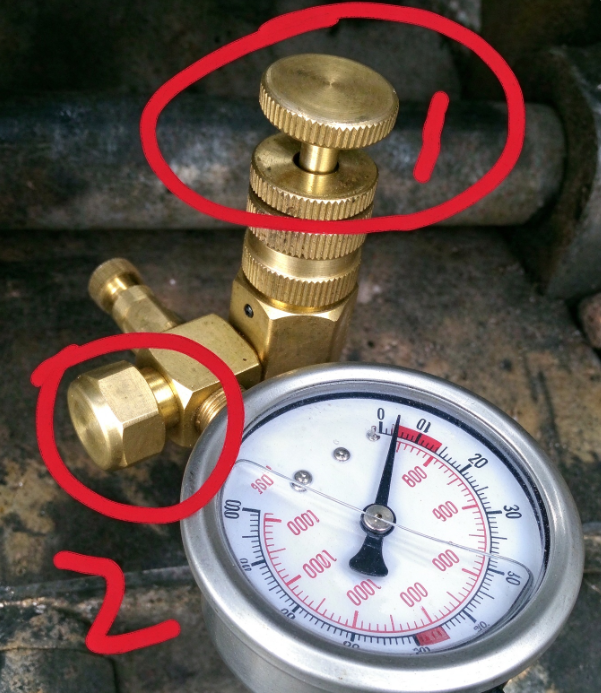
Make sure that the screw marked 2 in the image is properly installed. If it is not installed correctly, all the nitrogen may escape during pressure measurement.
To measure the nitrogen pressure, press the position marked 1 in the image to check how much nitrogen remains inside.
Step 4: Add Nitrogen
Referring to the image in Step 3, lift the pin at position 1 so that the pressure in the nitrogen gauge returns to zero.
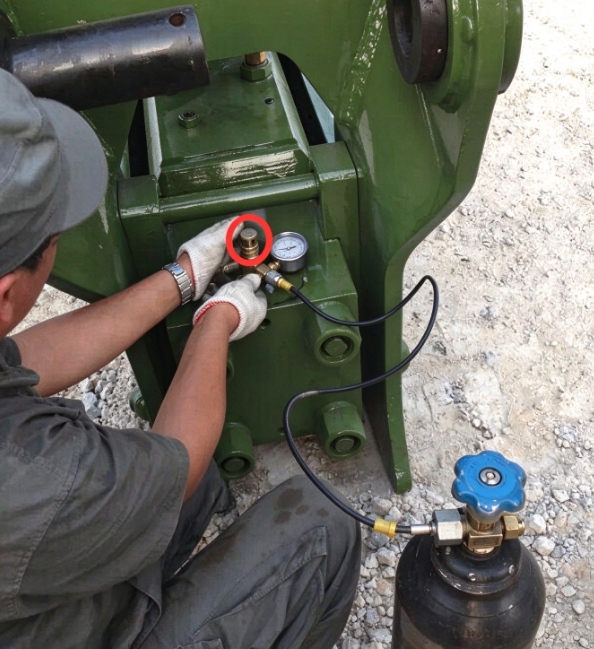
Then open the screw marked 2 and connect the nitrogen gauge to the nitrogen cylinder using the charging hose.
Step 5: Slowly Charge Nitrogen
Do not open the nitrogen cylinder fully and charge a large amount of gas at once.
Use the following method:
Open slowly → Observe the pressure → Close → Wait for the pressure to stabilize → Adjust again
Watch the pressure gauge while charging.
Stop charging when the pressure reaches the manufacturer’s specified value.
Step 6: Check the Final Pressure
After closing the nitrogen cylinder, allow the pressure to stabilize for a period of time and then check the pressure gauge reading again.
Once the pressure meets the specified value, remove the charging tool and reinstall the protective plug.
Conclusion
Nitrogen in a hydraulic breaker is mainly used to store and release energy, stabilize hydraulic pressure, and assist the piston during the impact process.
For hydraulic breakers equipped with an accumulator or a back-head nitrogen chamber, nitrogen pressure that is either too high or too low will affect normal operation.
Insufficient nitrogen may cause:
- Weak impact force
- Unstable pressure
- Abnormal accumulator operation
- Shortened diaphragm service life
Excessive nitrogen, on the other hand, may make it difficult for the hydraulic system to compress the gas, preventing the accumulator from storing energy properly and affecting breaker operation.
Therefore, the key to charging hydraulic breaker nitrogen is not “the more, the better,” but rather:
Charge nitrogen accurately according to the pressure specified for the specific brand and model.
At the same time, when a breaker becomes weak, nitrogen should not be the only item checked. Hydraulic pressure, flow, piston, control valve, accumulator, and seals should also be inspected together.
For hydraulic breakers using a diaphragm, regularly checking nitrogen pressure and diaphragm condition can help reduce unexpected downtime and repeated repairs.
FAQ
Why does a hydraulic breaker need nitrogen?
A hydraulic breaker uses nitrogen to store and release energy, stabilize hydraulic pressure, and assist the piston during the impact stroke. In some breakers, nitrogen is used in both the back head and the accumulator.
What happens if hydraulic breaker nitrogen pressure is too low?
If the nitrogen pressure is too low, the breaker may lose impact force, operate inefficiently, or show unstable pressure. Low nitrogen pressure can also increase stress on the accumulator diaphragm and shorten its service life.
What happens if too much nitrogen is added to a hydraulic breaker?
Excessive nitrogen pressure can prevent the hydraulic oil from properly compressing the gas inside the accumulator. This may reduce energy storage, affect impact performance, and in some cases prevent the breaker from operating normally.
How often should hydraulic breaker nitrogen pressure be checked?
The inspection interval depends on operating hours, working load, temperature, and application conditions. Breakers used in mining, quarrying, or other heavy-duty applications should be checked more frequently, especially if impact force decreases or nitrogen leakage is suspected.
Can compressed air be used instead of nitrogen in a hydraulic breaker?
No. Hydraulic breakers should use the gas specified by the manufacturer, normally dry nitrogen. Compressed air contains oxygen and moisture, which may contribute to oil oxidation, corrosion, and seal deterioration.


