

The hydraulic pump is one of the most important components in an excavator. It converts mechanical power from the engine into hydraulic flow, allowing the boom, arm, bucket, swing, travel, and auxiliary circuits to operate.
When an excavator hydraulic pump begins to wear, the machine may become slow, weak, noisy, or unusually hot. However, these symptoms do not automatically prove that the pump has failed. A blocked filter, suction leak, incorrectly adjusted relief valve, worn cylinder seals, leaking control valve, low engine speed, or contaminated hydraulic oil can produce similar problems.
Before ordering a replacement, the complete hydraulic system should be inspected and tested. Parker’s hydraulic troubleshooting guidance similarly recommends checking the relief valve, directional valves, actuators, oil level, suction conditions, fluid viscosity, engine speed, and other system components before blaming the pump.
This guide explains ten common signs of excavator hydraulic pump failure, how to separate pump problems from other hydraulic faults, and when to consider repair or replacement.
For help identifying the pump installed on your machine, first read How to Identify the Correct Hydraulic Pump for Your Excavator.
| Warning sign | Possible pump-related cause | Other possible causes |
|---|---|---|
| All hydraulic functions are slow | Low pump flow or internal wear | Low engine speed, restricted suction |
| Machine becomes weak when hot | Internal leakage increases with temperature | Thin oil, valve or cylinder leakage |
| Whining or rattling noise | Cavitation, aeration or bearing damage | Low oil, blocked filter, suction leak |
| Hydraulic oil overheats | Internal leakage and energy loss | Relief valve, cooler or contamination |
| Excessive case-drain flow | Worn rotating group | Incorrect oil viscosity |
| Pump cannot build pressure | Internal wear or regulator failure | Relief valve or control valve problem |
| Hydraulic movements are jerky | Unstable pump flow | Air in oil, pilot-pressure problem |
| Oil leaks around the pump | Shaft seal or housing seal damage | High case pressure or poor alignment |
| Oil becomes dark or smells burnt | Excessive operating temperature | Cooler failure or incorrect oil |
| Metal appears in filters or oil | Internal pump component wear | Failure elsewhere in the system |
1. All hydraulic functions become slow
One of the clearest warning signs is a noticeable reduction in the speed of several hydraulic functions.
You may notice that:
- The boom raises slowly
- The arm retracts slowly
- Bucket curl is weak
- Swing speed is reduced
- Travel speed is lower than normal
- Multiple functions cannot operate effectively together
When every major hydraulic function becomes slow, the main pump may not be delivering sufficient flow.
Possible pump-related causes include:
- Worn piston shoes
- Worn cylinder block
- Damaged valve plate
- Excessive internal clearance
- Regulator malfunction
- Low pump displacement
- Damaged drive shaft or coupling
However, slow operation can also be caused by low engine speed, restricted pump inlet flow, low oil level, pilot-pressure problems, or an incorrectly operating pump regulator.
Before removing the pump, confirm that the engine reaches its specified operating speed under load and that the suction line, tank breather, filter, and hydraulic oil level are correct.
2. The excavator becomes weak after the oil heats up
A worn hydraulic pump may perform reasonably well when the machine is cold but lose strength as the hydraulic oil reaches operating temperature.
As oil becomes warmer, its viscosity decreases. If the pump has excessive internal clearances, more oil can leak internally instead of being delivered to the hydraulic circuit.
Typical symptoms include:
- The excavator works normally after startup
- Digging force decreases after 20–40 minutes
- Boom lifting becomes weak when hot
- Travel becomes slower after extended operation
- Hydraulic pressure drops as the oil temperature rises
- Performance returns temporarily after the machine cools down
Parker’s troubleshooting documentation notes that high oil temperature and reduced viscosity can increase internal leakage. Excessive pump leakage should be evaluated through case-drain testing rather than assumed from temperature alone.
Hot-operation weakness may also result from:
- Main control valve leakage
- Worn cylinder piston seals
- Relief valve leakage
- Incorrect hydraulic oil
- Excessively high oil temperature
- Swing or travel motor internal leakage
Pressure, flow, and case-drain tests should be performed at normal operating temperature.
3. The pump makes whining、 rattling、or knocking noises
A hydraulic pump should not suddenly develop a loud whining, rattling, grinding, or knocking sound.
Different noises may suggest different problems:
| Noise | Possible cause |
|---|---|
| High-pitched whining | Restricted suction or cavitation |
| Rattling sound | Air entering the oil |
| Grinding sound | Bearing or internal component damage |
| Knocking sound | Severe cavitation or rotating-group damage |
| Pulsating noise | Unstable regulator or pressure fluctuation |
Cavitation happens when the pump cannot receive enough oil at the inlet. Air or vapor cavities form and collapse inside the pump, potentially damaging internal surfaces.
Common causes include:
Cold oil at high engine speed
Low hydraulic oil level
Blocked suction filter or strainer
Collapsed suction hose
Suction hose too small
Loose suction connection
Oil viscosity too high
Blocked tank breather
Pump installed too far above the oil level
Do not continue operating a pump that suddenly becomes noisy. Cavitation and lack of lubrication can quickly turn a minor inlet problem into major internal damage.
4. The hydraulic oil overheats
Hydraulic systems naturally generate heat, but an unusual or rapid temperature increase may indicate that hydraulic power is being lost through internal leakage.
A worn pump can circulate oil internally instead of sending usable flow to the machine. The lost energy is converted into heat.
Possible symptoms include:
- Hydraulic temperature warning
- Oil tank becoming unusually hot
- Performance declining as temperature rises
- Seals becoming hard or leaking
- Hydraulic oil developing a burnt smell
- Machine requiring frequent cool-down periods
Pump wear is only one possible cause. Excessive heat can also come from:
- Relief valve continuously opening
- Blocked hydraulic cooler
- Dirty cooler fins
- Cooling fan problem
- Incorrect oil viscosity
- Restricted hoses
- Control valve internal leakage
- Motor or cylinder leakage
- Low reservoir oil level
- Contaminated hydraulic oil
Measure the oil temperature rather than judging it only by touch.
5. Case-Drain flow becomes excessive
Variable-displacement piston pumps normally produce some internal leakage. This leakage lubricates and cools internal components before returning to the tank through the case-drain line.
As the rotating group wears, internal leakage can increase.
Possible worn components include:
- Pistons and piston shoes
- Cylinder block
- Valve plate
- Swash plate
- Bearings
- Shaft sealing surfaces
- Internal bushings
Excessive case-drain flow is one of the more useful indicators of internal pump wear. Parker service information specifically recommends checking case-drain flow when excessive pump leakage is suspected.
The test must follow the pump manufacturer’s procedure because acceptable leakage depends on:
- Pump model
- Oil temperature
- Operating pressure
- Pump speed
- Displacement setting
- Case pressure
Never block the case-drain line. A restricted drain can increase housing pressure, damage the shaft seal, and create external leakage.
6. The pump cannot reach the required pressure
A failing pump may be unable to build or maintain the hydraulic pressure required for heavy work.
You may notice:
- The boom cannot lift a normal load
- The bucket cannot break into hard material
- The arm stops under resistance
- The excavator cannot climb a slope
- Travel stalls under load
- Pressure rises slowly or fluctuates
- Maximum pressure is below specification
Possible pump-related causes include:
- Worn rotating group
- Damaged valve plate
- Regulator failure
- Broken internal spring
- Worn control piston
- Incorrect pump displacement
- Severe internal leakage
However, low pressure is not enough to condemn the pump.
It may also be caused by:
- Main relief valve set too low
- Relief valve stuck open
- Control valve spool leakage
- Damaged cylinder seals
- Travel or swing motor leakage
- Low pilot pressure
- Engine speed dropping under load
- Incorrect pressure-testing procedure
Pressure should be measured at the correct test port under the conditions specified in the machine service manual.
7. Hydraulic movements become jerky or unstable
A failing or poorly supplied pump may produce irregular flow, causing actuators to hesitate, shake, or move unpredictably.
Symptoms may include:
- Boom movement that pauses or jumps
- Bucket cylinder vibration
- Swing speed that rises and falls
- Travel surging
- Pump pressure oscillation
- Noise changing with each movement
- Foamy or milky hydraulic oil
Jerky operation is often associated with air entering the hydraulic system.
Possible causes include:
- Loose suction fitting
- Cracked suction hose
- Low oil level
- Incorrect tank return arrangement
- Oil foaming
- Pump not properly primed
- Restricted inlet
- Regulator instability
- Pilot-pressure fluctuation
Before replacing the pump, inspect the suction side carefully. A small air leak may not release oil externally but can still draw air into the pump.
8. Oil leaks around the pump shaft or housing
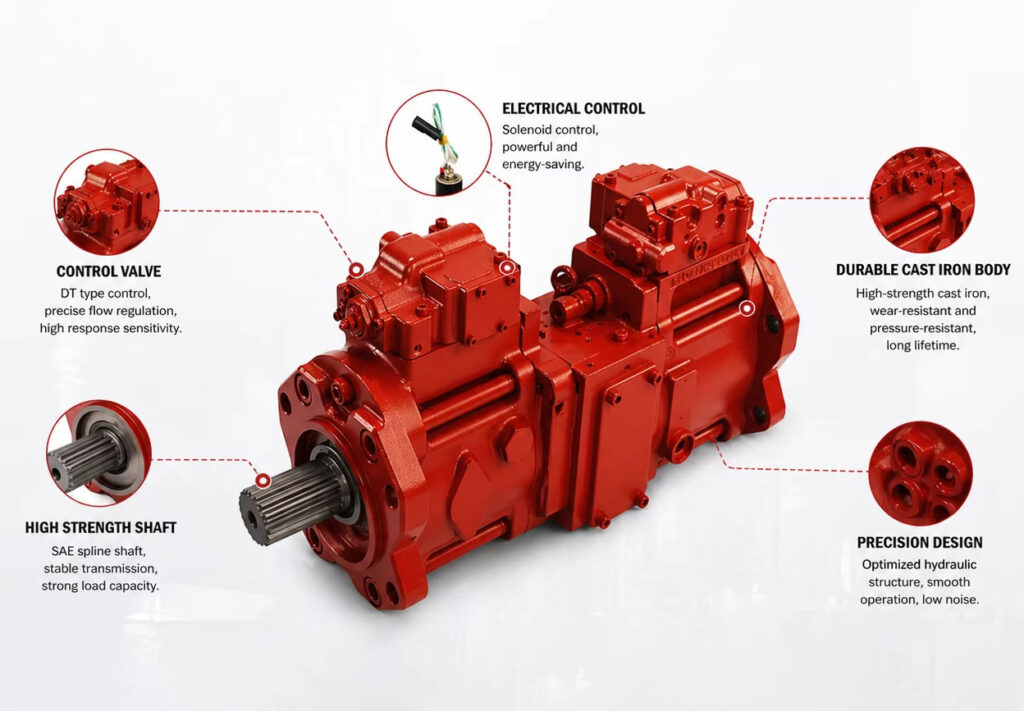
Visible hydraulic oil around the pump does not always mean the entire pump must be replaced, but it should not be ignored.
Common leakage locations include:
- Input shaft seal
- Pump housing joints
- Regulator seals
- Control piston covers
- Port flanges
- Pilot pump connections
- Case-drain fitting
- Solenoid or sensor areas
Possible causes include:
- Worn shaft seal
- Shaft scoring
- Excessive case pressure
- Restricted case-drain line
- Misaligned coupling
- Damaged bearing
- Loose housing bolts
- Hardened O-rings
- Excessive operating temperature
- Incorrect previous installation
Replacing only the shaft seal may provide a temporary repair if the actual cause is excessive internal leakage or high housing pressure.
9. The hydraulic oil becomes dark or smells burnt
Healthy hydraulic oil should maintain the appearance and condition specified by the machine and oil manufacturer.
Warning signs include:
- Dark or blackened oil
- Burnt smell
- Varnish deposits
- Sticky valve components
- Hardened seals
- Reduced lubrication
- Repeated overheating
Dark oil does not prove that the pump is damaged, but it shows that the hydraulic system has been exposed to excessive heat, oxidation, contamination, or an incorrect oil-service interval.
Degraded oil can accelerate wear in:
- Pumps
- Control valves
- Hydraulic motors
- Cylinders
- Bearings
- Regulators
- Servo pistons
Before installing replacement parts:
- Find the source of excessive heat.
- Inspect the hydraulic cooler.
- Check the relief-valve setting.
- Test for internal leakage.
- Replace oil and filters where required.
- Clean or flush contaminated components according to the service procedure.
A new pump installed into overheated or contaminated oil may fail again quickly.
10. Metal particles appear in the oil or filters
Metal particles in the hydraulic filter, tank, case-drain oil, or pump housing are a serious warning sign.
Possible materials include:
- Steel particles
- Brass or bronze material
- Aluminum fragments
- Bearing material
- Black friction debris
- Fine metallic powder
Internal pump damage may affect:
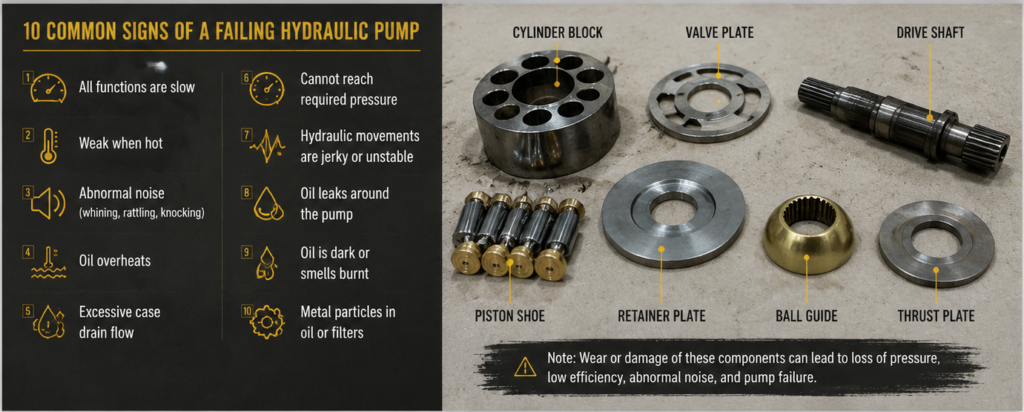
- Valve plate
- Cylinder block
- Piston shoes
- Swash plate
- Bearings
- Drive shaft
- Retainer plate
- Pump housing
However, contamination can travel throughout the hydraulic system. The particles may come from a travel motor, swing motor, cylinder, valve, final drive interface, or another damaged component.
Do not install a replacement pump until the source has been identified.
The system may require inspection or cleaning of:
- Hydraulic tank
- Suction line
- Return line
- Main control valve
- Oil cooler
- Hoses
- Cylinders
- Swing motor
- Travel motors
- Filters and screens
Hydraulic component manufacturers emphasize fluid cleanliness because contamination can cause premature wear, jamming, clogging, and further component damage.
Symptoms that do not automatically mean pump failure
The following problems are frequently blamed on the hydraulic pump even though another component may be responsible.
only one hydraulic function is weak
When only the boom, arm, bucket, swing, or one travel side is weak, inspect the related:
- Cylinder
- Motor
- Control valve section
- Port relief valve
- Hose
- Pilot circuit
A main pump problem usually affects more than one function, although tandem-pump sections can affect separate circuit groups.
The boom drifts down
Boom drift may be caused by cylinder piston-seal leakage, holding-valve leakage, control-valve leakage, or hose failure.
One travel side is slow
Possible causes include:
- Travel motor
- Final drive
- Center joint
- Travel valve
- Brake release pressure
- Track tension
- Hose restriction
- One pump section
The machine is weak at low engine speed
Check the engine, throttle control, fuel system, speed sensor, coupling, and pump-control signal before replacing the hydraulic pump.
How to confirm excavator hydraulic pump failure
A reliable diagnosis normally requires more than one test.
Check the hydraulic oil
Confirm:
- Correct oil type
- Correct oil level
- Oil condition
- Operating temperature
- Signs of water or air
- Metal contamination
Inspect the suction system
Check:
- Suction hose
- Hose clamps
- Tank breather
- Suction strainer
- Oil level
- Collapsed hose lining
- Air leaks
- Inlet vacuum
Verify engine speed
The pump cannot provide its expected flow if the engine does not reach the required speed.
Measure:
Speed drop during pressure testing
No-load engine speed
Engine speed under hydraulic load
Test hydraulic pressure
Compare measured pressure with the machine service specifications.
Test:
- Main system pressure
- Pilot pressure
- Pump-control pressure
- Travel pressure
- Swing pressure
- Individual circuit pressure
Measure pump flow
A flow test shows whether the pump can deliver the required oil volume at a specified speed, pressure, and temperature.
Measure case-drain flow
Excessive case-drain flow can indicate internal pump wear. Follow the specific pump manufacturer’s testing procedure.
Isolate other components
Test the:
- Main relief valve
- Control valve
- Cylinders
- Center joint
- Swing motor
- Travel motors
- Pump regulator
Do not replace the most expensive component first simply because it is suspected.
Repair kit or complete hydraulic pump?
A pump repair may be suitable when:
- The housing is reusable
- The drive shaft is serviceable
- The regulator can be repaired or calibrated
- Damage is limited to replaceable internal parts
- The complete pump model is known
- Professional rebuilding and testing equipment is available
Possible repair parts include:
- Cylinder block
- Valve plate
- Piston shoe assembly
- Retainer plate
- Ball guide
- Swash plate
- Drive shaft
- Bearings
- Seal kit
- Regulator parts
FAQ:
Can a hydraulic pump fail without making noise?
Yes. A worn pump may lose flow or develop excessive internal leakage without producing obvious noise. Pressure, flow, temperature, and case-drain testing may be required.
Why does my excavator work when cold but become weak when hot?
Lower oil viscosity at operating temperature can increase leakage through worn pump, valve, motor, or cylinder clearances. The pump should not be replaced until the possible leakage sources are tested.
Does low hydraulic pressure always mean a bad pump?
No. A low relief-valve setting, leaking control valve, worn cylinder, motor leakage, low pilot pressure, incorrect engine speed, or restricted suction can also reduce pressure.
Can I continue operating a noisy hydraulic pump?
Continued operation is not recommended until the cause is identified. Cavitation, aeration, low oil supply, and bearing damage can rapidly increase internal wear.
Can I replace only the shaft seal?
The shaft seal can sometimes be replaced separately, but the shaft, bearing, alignment, case pressure, drain line, and internal leakage should also be checked.
Should the hydraulic system be flushed after a pump failure?
When a pump failure releases metal particles or other contamination, affected tanks, hoses, valves, coolers, motors, cylinders, and filters should be inspected and cleaned according to the machine manufacturer’s repair procedure.
How do I find the correct replacement pump?
Provide the complete machine model, serial number, pump nameplate, OEM part number, full pump model, and photos. Do not order using only a general excavator model or product appearance.
Find Excavator Hydraulic Pump Parts at FarinParts
FarinParts supplies replacement hydraulic components and repair parts for excavators, loaders, bulldozers, backhoe loaders, road machinery, agricultural equipment, and other heavy equipment.
Available options include:
- Complete hydraulic pumps
- Main excavator pumps
- Piston pumps
- Gear pumps
- Pump regulators
- Pump repair kits
- Cylinder blocks
- Valve plates
- Piston shoe assemblies
- Retainer plates
- Drive shafts
- Bearings
- Seal kits
Browse the FarinParts online shop by machine model, part number, pump model, or product name.
Conclusion
Slow operation, loss of power, abnormal noise, high temperature, excessive case-drain flow, external leakage, burnt oil, and metal contamination can all indicate an excavator hydraulic pump problem.
However, none of these symptoms should be used alone to diagnose pump failure. Relief valves, control valves, cylinders, motors, oil condition, engine speed, pilot pressure, suction restrictions, and cooling problems can produce similar symptoms.
The most reliable process is to:
- Inspect the oil and suction system
- Verify engine speed
- Measure pressure and flow
- Test case-drain leakage
- Check valves, cylinders, and motors
- Inspect the pump and contamination
- Confirm the complete pump model before ordering
Taking time to diagnose the system correctly can prevent unnecessary pump replacement, repeated failure, extra freight costs, and avoidable machine downtime.


