


Excavator hydraulic problems can be difficult to diagnose because very different faults may produce similar symptoms.
A machine with normal speed but weak digging force may have a pressure or internal leakage problem. An excavator with high hydraulic oil temperature may not necessarily have a cooling system failure. And when only certain functions become slow, the actual problem may be a control valve, solenoid, or pump combining circuit rather than the main hydraulic pump itself.
Effective excavator hydraulic troubleshooting should follow a logical process:
Symptoms → Pressure Testing → Flow Testing → Control Signals → Hydraulic Schematic Analysis → Component Inspection
Effective excavator hydraulic troubleshooting starts by determining whether the problem is related to pressure, flow, internal leakage, or the hydraulic control system.
The following three real repair case studies show how this approach can prevent unnecessary parts replacement.
1.Common Excavator Hydraulic Troubleshooting Problems
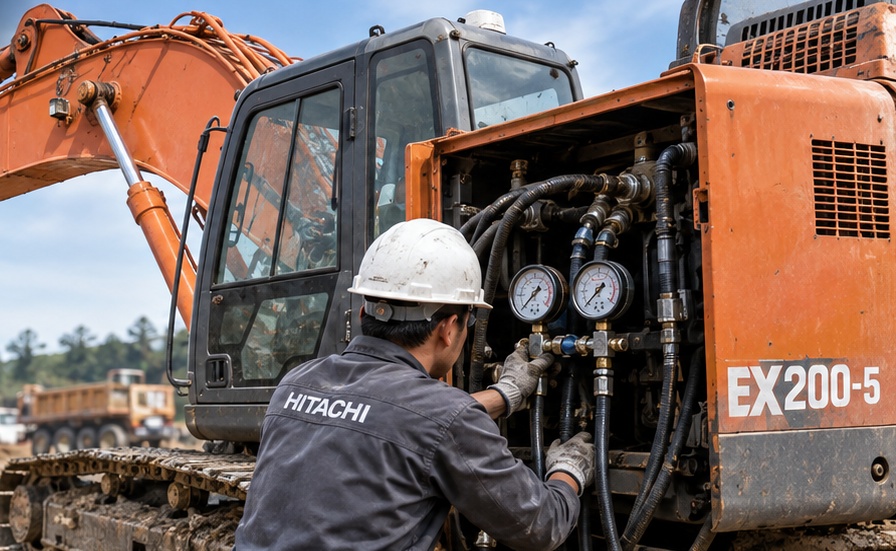
Case 1: Hitachi EX200-5 Has Normal Speed but Weak Hydraulic Power
Symptoms:Hitachi EX200-5 excavator could still move its work equipment at approximately normal speed, but hydraulic power was noticeably weak.
The boom was particularly weak under load.
This type of symptom is important because:
When hydraulic speed remains relatively normal but working force is low, the problem is often related to pressure loss rather than insufficient pump flow.Symptoms:R290LC excavator developed unusually high hydraulic oil temperature during operation.
Possible Cause 1: Restricted Hydraulic Oil Passage
A restriction in the hydraulic circuit can reduce the amount of oil reaching the actuator.
Possible locations include:
- Main control valve passages
- Hydraulic filters
- Small control orifices
- Hydraulic hoses
- Valve spool passages
Contaminated hydraulic oil may contain seal fragments, metal particles, or other debris capable of restricting these passages.
Possible Cause 2: Hydraulic Leakage
Hydraulic leakage can be external or internal.
Common external leakage points include:
- Loose hose fittings
- Damaged O-rings
- Deteriorated seals
- Damaged hydraulic hoses
- Incorrect assembly
Internal leakage is more difficult to detect.
High-pressure oil may leak internally through:
- Main control valves
- Hydraulic cylinders
- Hydraulic pumps
- Relief valves
The excavator may still operate, but available working force is reduced.
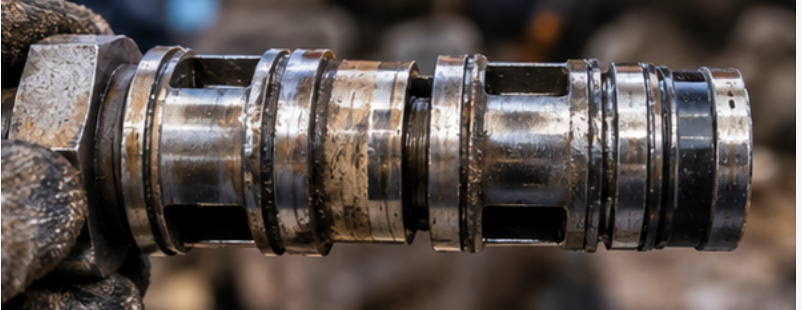
Possible Cause 3: Boom Spool Internal Leakage
If the boom is weak while other functions remain normal, the boom spool in the main control valve should be inspected.
Possible problems include:
- Worn spool
- Worn valve bore
- Sticking spool
- Excessive internal clearance
- Internal cross-port leakage
If too much high-pressure oil escapes through internal clearances, the boom cylinder cannot receive sufficient working pressure.
Possible Cause 4: Boom Cylinder Internal Leakage
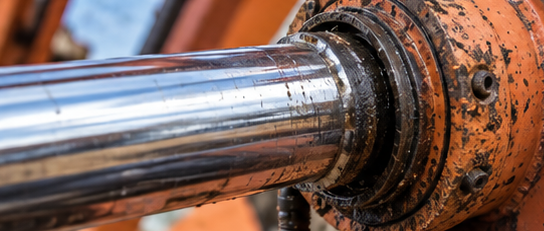
A damaged piston seal can allow high-pressure oil to bypass from one side of the piston to the other.
Typical symptoms include:
- Weak boom lifting
- Poor load holding
- Boom drift
- Greater weakness after the hydraulic oil becomes hot
Because the leakage occurs inside the cylinder, there may be no visible external oil leak.
EX200-5 Troubleshooting Strategy
In excavator hydraulic troubleshooting, normal operating speed combined with weak digging force usually suggests a pressure-loss or internal-leakage problem rather than insufficient pump flow.
For an excavator that has:
Normal speed + weak power
check the following first:
System Pressure → Main Relief Valve → Main Control Valve Leakage → Boom Spool → Cylinder Internal Leakage
This is a good example of why excavator hydraulic troubleshooting should not begin by immediately rebuilding the hydraulic pump.
If pump flow is still adequate, machine speed may remain normal even though system pressure cannot be maintained.
Case 2: R290LC Hydraulic Oil Overheating and Slow Operation
During excavator hydraulic troubleshooting, unusually high no-load pressure should never be ignored because it can generate excessive heat even when the cooling system is working normally.
Symptoms:R290LC excavator developed unusually high hydraulic oil temperature during operation.
Testing showed:
- Rear main pump no-load pressure: approximately 10 MPa
- At rated engine speed, rear pump no-load pressure exceeded 20 MPa
- Functions supplied by the rear pump were also slower than normal
These symptoms initially appeared contradictory.
High no-load pressure indicated excessive hydraulic resistance, while slow actuator movement suggested insufficient pump displacement or flow.
Step 1: Inspect the Main Control Valve
The first possibility was a main control valve spool that was not returning completely to neutral.
If a spool remains partially shifted, the main pump may stay loaded even when no function is being operated.
Inspection found:
- No obvious sticking in the rear-pump side of the main control valve
- No abnormal spool position
- The spare valve section most likely to remain off-center was located on the front-pump side
The rear main control valve was therefore not the primary cause.
Step 2: Inspect the Recently Rebuilt Main Pump
The maintenance history revealed an important clue:
The hydraulic main pump had recently been repaired.
Because the rear-pump functions were slow, attention shifted to the variable-displacement mechanism.
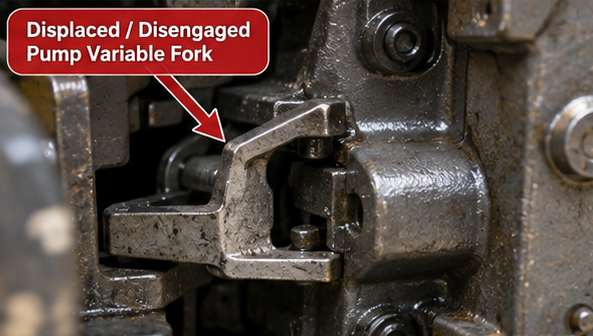
After disassembling the pump, technicians found that the:
Pump displacement fork had disengaged and shifted.
This prevented the swash plate from moving correctly and left the pump operating at relatively low displacement.
That explained the slow hydraulic functions:
Reduced swash plate angle → Reduced pump displacement → Reduced hydraulic flow → Slow actuator speed
The cause was traced to:
- Insufficient fastening force
- Failure to apply the specified thread-locking compound
The variable mechanism was repaired and reassembled correctly.
Step 3: No-Load Pressure Was Still Too High
After repairing the pump, actuator speed improved.
However,the abnormal high no-load pressure remained.
This meant the excavator had two separate hydraulic faults.
This is an important lesson in excavator hydraulic troubleshooting:finding one fault does not mean every symptom is caused by that same fault.
Step 4: Inspect the B-Port Logic Valve
Analysis of the hydraulic schematic showed that the B-port logic valve could cause excessive rear-pump no-load pressure.
If an unwanted signal pressure acted on the B port, the valve could restrict the main hydraulic circuit and prevent normal unloading.
The B-port signal line was disconnected and the machine was tested again.
The result:the high no-load pressure remained.
Therefore, the abnormal pressure was not being caused by an external control signal.
Step 5: Disassemble the Logic Valve
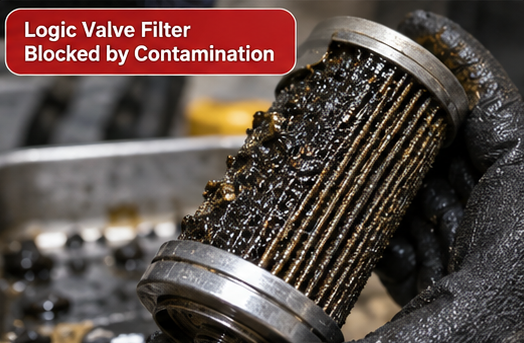
Further inspection of the logic valve revealed a small filter located behind its restriction orifice.
After disassembly:the filter was found completely blocked by contamination.
Because the filter was blocked, pressure inside the logic valve could not release normally.
The result was:
Main pump cannot unload properly → No-load pressure remains high → Hydraulic energy is converted into heat → Hydraulic oil temperature rises
The filter was cleaned and the hydraulic system was reassembled.
After testing:
- No-load pressure returned to normal
- Hydraulic functions operated correctly
- Hydraulic oil temperature returned to normal
What the R290LC Case Teaches Us
This machine had two independent faults.
Fault 1: Pump displacement mechanism shifted
Result:Low pump displacement → Insufficient flow → Slow hydraulic functions
Fault 2: Logic valve filter blocked
Result:High no-load pressure → Continuous energy loss → Hydraulic overheating
Therefore, when an excavator has:
Slow operation + high hydraulic temperature
do not simply assume the hydraulic pump is worn.
Both pump flow and unnecessary pressure loss must be investigated.
Case 3: Komatsu PC200-6 Boom Lifts Slowly
Symptoms:Komatsu PC200-6 developed the following problem:
- Boom lifting was slow
- Arm-in operation was also slow
- No obvious boom or arm cylinder drift
- Bucket, swing, travel, and other functions were normal
Because the cylinders were not drifting noticeably, severe cylinder internal leakage was less likely.
The next step was to check pump pressures and the two-pump combining system.
Step 1: Measure Front and Rear Pump Pressure
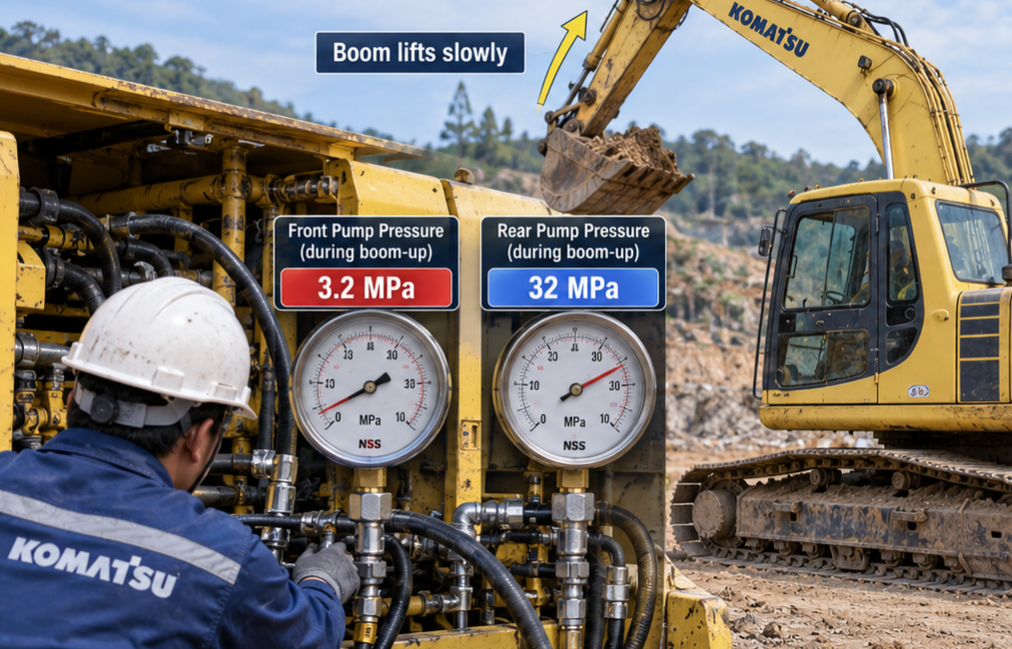
During boom lifting under load:
- Front pump pressure: approximately 3.2 MPa
- Rear pump pressure: approximately 32 MPa
During full arm-in operation:
- Front pump pressure: approximately 32 MPa
- Rear pump pressure: approximately 3.3 MPa
This was a very important diagnostic result.
Boom lifting and arm-in normally require high hydraulic flow, so both pumps should combine their flow under the appropriate operating conditions.
However, the pressure readings showed that:only one pump was effectively supplying each operation.
The two pumps were not combining correctly.
Why the Boom Was Slow?
With only one main pump providing effective flow:
- The boom could still lift
- The arm could still retract
- Hydraulic pressure could still build
But the available flow was approximately reduced because the second pump was not joining the circuit.
This produced:normal or near-normal force, but slow operating speed.
Step 2: Analyze the Pump Combining Control System
On the PC200-6, pump combining and separation are controlled through a combination of:
Work equipment signal → Pressure sensor → Controller → Pump combine/separate solenoid valve → Hydraulic circuit
Possible fault sources therefore included:
- Pressure sensors
- Controller
- Wiring
- Combine/separate solenoid valve
- Hydraulic control circuit
Step 3: Check the Pressure Sensors
The boom-up and arm-in pressure sensors were tested.
Result:the sensors were operating normally.
The diagnosis moved to the pump combine/separate solenoid valve.
Step 4: Check Solenoid Valve Outlet Pressure
During a condition that should command pump combining, such as boom lifting, the outlet pressure of the combine/separate solenoid valve was checked.
Result:no control pressure was present at the valve outlet.
Two possibilities remained:
- The controller was not sending the correct electrical command.
- The solenoid valve itself had failed.
Step 5: Check Controller Output Voltage
A multimeter was used to check the voltage from the controller to the solenoid valve.
During pump combining:24.6 V
During pump separation:0 V
These readings were normal.
This confirmed that:
- The controller recognized the operating condition correctly
- The electrical command was correct
- The wiring was functioning
The fault was therefore most likely inside the solenoid valve.
Step 6: Disassemble the Solenoid Valve
The combine/separate solenoid valve was removed and disassembled.
Inspection found:the valve needle was bent and stuck inside the valve body.
Although the solenoid received the correct 24.6 V signal, the internal valve could not move.
It remained permanently in the:pump Separation Position
As a result, boom-up and arm-in operations could not receive combined flow from both pumps.
The solenoid valve was replaced.
After replacement:
- Boom lifting speed returned to normal
- Arm-in speed returned to normal
- Front and rear pumps combined correctly
The problem was resolved.
1.Comparison of the Three Excavator Hydraulic Troubleshooting Cases
| Machine | Main Symptom | Main Fault Area | Key Diagnostic Method |
|---|---|---|---|
| EX200-5 | Normal speed but weak power | Pressure loss / internal leakage | Pressure and leakage testing |
| R290LC | Hydraulic overheating and slow functions | Pump control + logic valve restriction | No-load pressure and pump inspection |
| PC200-6 | Slow boom and arm operation | Pump combining solenoid valve | Pump pressure and electrical testing |
These three cases represent three important hydraulic troubleshooting patterns.
1.1 Normal Speed but Weak Power
Focus on:hydraulic pressure problems
Possible causes include:
- Relief valve leakage
- Main control valve leakage
- Cylinder internal leakage
- Damaged valve spools
1.2 Slow Operation and High Hydraulic Oil Temperature
Focus on:pump flow + hydraulic pressure loss
Possible causes include:
- Pump displacement problems
- Valve restrictions
- High no-load pressure
- Blocked hydraulic passages
1.3 Only Certain Functions Are Slow
Focus on:common hydraulic control circuits
Possible causes include:
- Pump combining system
- Solenoid valves
- Pilot pressure
- Pressure sensors
- Electrical control signals
2.Recommended Excavator Hydraulic Troubleshooting Sequence
A systematic excavator hydraulic troubleshooting procedure helps technicians identify the actual fault before disassembling the main pump, control valve, or hydraulic cylinders.
Systematic diagnosis should generally follow this order:
1. Confirm the exact symptoms
↓
2. Determine whether one function or multiple functions are affected
↓
3. Measure hydraulic system pressure
↓
4. Measure hydraulic pump flow when necessary
↓
5. Check pilot and control pressure
↓
6. Check sensors and solenoid valve signals
↓
7. Analyze the hydraulic schematic
↓
8. Inspect internal components only after testing
3.Common Excavator Hydraulic Troubleshooting Mistakes
One of the biggest mistakes in excavator hydraulic troubleshooting is replacing expensive hydraulic components before pressure, flow, and control signals have been properly tested.
Another is:“The hydraulic oil is hot, so the cooler must be bad.”
In reality, similar symptoms may be caused by:
- Main control valve leakage
- Pilot control faults
- Blocked filters
- Restricted oil passages
- Sticking solenoid valves
- Pump regulator problems
- Internal cylinder leakage
- Contamination
A small restriction or control valve failure can sometimes create symptoms similar to a major pump failure.
4.Conclusion
Successful excavator hydraulic troubleshooting requires technicians to analyze pressure, flow, control signals, and internal leakage together rather than relying on one symptom alone.
Effective excavator hydraulic troubleshooting depends on understanding the relationship between:
Pressure + Flow + Control Signal + Internal Leakage
The EX200-5 case shows why normal hydraulic speed does not necessarily mean the system can maintain sufficient pressure.
The R290LC case demonstrates that hydraulic overheating can result from excessive no-load pressure and control valve restrictions, not only from cooling problems.
The PC200-6 case shows that even when the electrical control signal is correct, a mechanically stuck solenoid valve can still prevent the hydraulic system from operating properly.
A reliable diagnosis should combine:
Pressure Testing + Flow Testing + Electrical Testing + Hydraulic Schematic Analysis + Component Inspection
This method helps reduce misdiagnosis, unnecessary downtime, and the cost of replacing hydraulic pumps, main control valves, cylinders, and other expensive components.
Technical Note: The pressure and voltage values in these examples come from specific repair cases and are provided to explain troubleshooting logic. Specifications can vary by machine serial number, production year, and hydraulic configuration. Always use the correct service manual before performing pressure adjustments or hydraulic repairs.
FAQ
1.What are the most common causes of weak excavator hydraulic power?
Common causes include low system pressure, internal leakage, worn control valve spools, cylinder seal leakage, relief valve problems, restricted hydraulic passages, and pump control faults. The correct diagnosis depends on whether the machine is slow, weak, overheating, or only certain functions are affected.
2.Why does an excavator have normal speed but weak digging force?
If hydraulic speed is normal but digging force is weak, the problem is often related to pressure loss rather than insufficient pump flow. Possible causes include internal leakage in the main control valve, boom cylinder leakage, worn spool clearances, or a relief valve that cannot maintain the required pressure.
3.What causes high hydraulic oil temperature in an excavator?
High hydraulic oil temperature may be caused by excessive no-load pressure, internal leakage, restricted valves, blocked filters, incorrect pump displacement control, or poor hydraulic cooling. A hydraulic system that cannot unload properly can continuously convert hydraulic energy into heat.
4.Why is the excavator boom slow while other functions are normal?
If only the boom or a small group of functions is slow, the fault may be in a shared control circuit rather than the main pump. Possible causes include a pump combining solenoid valve, pilot pressure problem, pressure sensor fault, stuck control valve, or an electrical control issue.
5.What is the best way to troubleshoot an excavator hydraulic problem?
A good excavator hydraulic troubleshooting process should begin with the symptoms, then check system pressure, pump flow, pilot pressure, control signals, and internal leakage. Hydraulic schematic analysis should be used before disassembling expensive components such as the main pump or control valve.


