
Choosing between hydraulic pump repair vs replacement can be difficult when an excavator becomes slow, weak, noisy, or unusually hot.
The following hydraulic pump repair vs replacement guide compares the most important conditions before you spend money on parts or labor.
Quick Hydraulic Pump Repair vs Replacement Guide
| Pump condition | Repair may be suitable | Replacement may be better |
|---|---|---|
| Housing is undamaged and reusable | ✓ | |
| Shaft and bearing seats are within specification | ✓ | |
| Damage is limited to replaceable internal parts | ✓ | |
| Correct repair parts are available | ✓ | |
| Professional measuring and testing equipment is available | ✓ | |
| Pump housing is cracked or distorted | ✓ | |
| Shaft splines or bearing seats are severely damaged | ✓ | |
| Regulator housing is damaged | ✓ | |
| Several major internal groups have failed | ✓ | |
| Previous repairs have repeatedly failed | ✓ | |
| Metal contamination has spread throughout the system | Depends | ✓ |
| Machine must return to work immediately | ✓ | |
| Correct repair parts cannot be identified | ✓ |
Tips:a low-cost repair is not always the least expensive option. Repeated removal, installation, cleaning, oil replacement, testing, freight, and machine downtime can quickly exceed the price difference between rebuilding and replacing the pump.
1. Confirm That the Hydraulic Pump Is Actually Failing
Before deciding whether to repair or replace the pump, first confirm that the pump is the source of the problem.
Slow hydraulic movement, low pressure, high oil temperature, abnormal noise, or weak digging force can also result from:
- Low engine speed
- Restricted pump suction
- Low hydraulic oil level
- Incorrect oil viscosity
- Blocked filters or strainers
- Main relief valve problems
- Pump regulator faults
- Main control valve leakage
- Worn cylinder piston seals
- Swing motor leakage
- Travel motor leakage
- Pilot-pressure problems
- Air entering the suction line
For example, if only the boom is weak while the bucket, arm, swing, and travel functions remain normal, the problem may be in the boom cylinder, control valve section, port relief valve, or related hose—not necessarily the main pump.
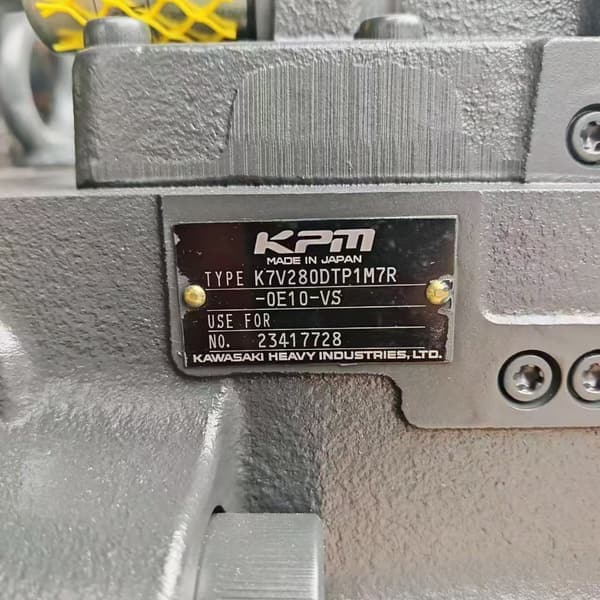
If several major functions become slow at the same time, the main pump, engine speed, suction supply, or pump-control system becomes more likely.
Before removing the pump, review the 10 critical signs of an excavator hydraulic pump failure. That guide explains pressure loss, excessive case-drain flow, abnormal noise, overheating, external leakage, and metal contamination in more detail.
Tests to perform before making a decision
A reliable diagnosis may include:
Hydraulic oil level and condition inspection
Suction hose and strainer inspection
Engine-speed test
Main system pressure test
Pilot-pressure test
Pump-control pressure test
Flow test at the specified speed and temperature
Case-drain flow test
Hydraulic oil temperature measurement
Inspection of filters and oil samples for metal
Do not replace the most expensive component simply because it is suspected.
2. Evaluate the Extent of Internal Pump Damage
After testing confirms a pump problem, the next step is to determine how much of the pump is damaged.
A piston pump normally contains several precision components that work together:
| Pump component | Common damage to inspect |
|---|---|
| Piston shoes | Scoring, loose shoes, uneven contact or heat damage |
| Cylinder block | Port-face wear, bore wear, cracks or discoloration |
| Valve plate | Grooves, burning, cavitation erosion or uneven wear |
| Swash plate | Scoring, pitting or uneven contact patterns |
| Retainer plate | Cracks, distortion or excessive wear |
| Ball guide | Wear, damage or excessive clearance |
| Drive shaft | Spline wear, scoring, bending or seal-surface damage |
| Bearings | Roughness, looseness, discoloration or pitting |
| Regulator | Sticking, internal wear or damaged control components |
| Housing | Cracks, worn bores, damaged threads or distortion |
| Seals | Hardening, cutting, extrusion or heat damage |
Repair may be reasonable when damage is limited to replaceable components such as:
- Piston shoe assembly
- Cylinder block
- Valve plate
- Retainer plate
- Ball guide
- Swash plate
- Bearings
- Seal kit
- Selected regulator parts
However, replacing a few visibly worn parts without measuring the mating surfaces and clearances can lead to another failure. A new valve plate, for example, may not operate correctly against a severely worn cylinder block.
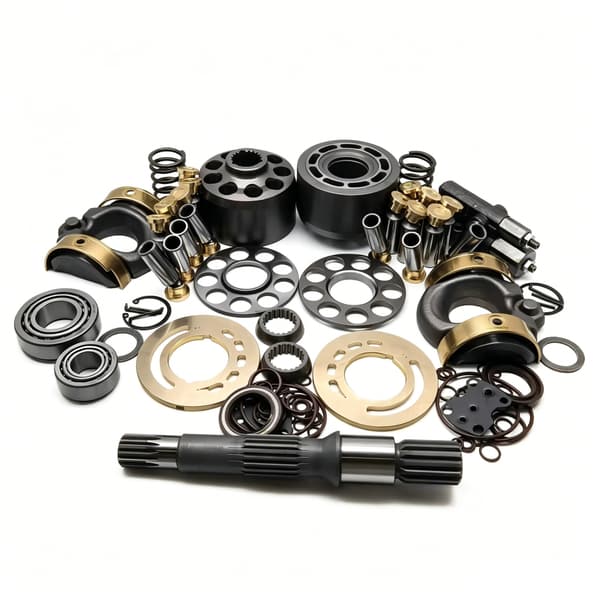
The condition of the entire rotating group should be evaluated as a matched system.
FarinParts supplies model-specific rebuild options such as the 708-25-00010 HPV90 hydraulic repair kit for Komatsu PC200-3, which includes major rotating-group and shaft components.
3. Inspect the Housing, Shaft, Bearings, and Regulator
The condition of the reusable core is one of the most important factors in a hydraulic pump rebuild.
Pump housing
A pump housing may be unsuitable for rebuilding when it has:
- Cracks
- Distortion
- Severely worn bearing bores
- Damaged control passages
- Stripped port threads
- Damaged regulator mounting surfaces
- Previous machining beyond acceptable limits
Minor surface damage may sometimes be repairable, but structural damage can make a complete replacement safer.
Drive shaft and splines
Inspect the drive shaft for:
- Twisted or worn splines
- Cracks
- Bending
- Bearing-journal wear
- Scoring at the shaft-seal surface
- Damage caused by coupling misalignment
Replacing only the shaft seal will not solve leakage caused by a worn shaft, failed bearing, restricted case-drain line, or excessive housing pressure.
Bearings and bearing seats
A new bearing cannot restore a housing with an excessively worn bearing seat. Movement between the bearing and housing can affect shaft alignment and rotating-group contact.
Regulator and controls
Variable-displacement pumps depend on regulators, servo pistons, springs, solenoids, sensors, and pilot-pressure signals.
A pump may produce poor performance even when the rotating group is still usable if the regulator is sticking, incorrectly adjusted, or internally worn. Conversely, installing a new regulator will not restore a severely worn rotating group.
The regulator must also match the machine configuration. Two pumps with a similar main casting can use different:
- Control types
- Solenoids
- Connectors
- Pressure settings
- Horsepower-control arrangements
- Pilot ports
- Mounting positions
4. Determine Whether Contamination Has Spread
Contamination can completely change the hydraulic pump repair vs replacement decision, especially when metal particles have spread into valves, motors, cylinders, hoses, or the oil cooler.Metal found in the hydraulic filter or oil changes the repair decision significantly.
Particles from a damaged pump can circulate through:
- Hydraulic tank
- Suction and return lines
- Oil cooler
- Main control valve
- Cylinders
- Swing motor
- Travel motors
- Center joint
- Case-drain circuits
- Hoses
- Filters and strainers
Contamination can also originate elsewhere in the system and then damage the pump.
5. Consider the Repair Shop’s Equipment and Experience
A hydraulic pump rebuild involves more than replacing old parts with new ones.
A qualified rebuilding process may require:
- Complete disassembly
- Controlled cleaning
- Dimensional measurement
- Surface inspection
- Housing and shaft inspection
- Bearing-clearance checks
- Rotating-group inspection
- Correct assembly orientation
- Accurate torque procedures
- Regulator inspection and calibration
- Clean priming
- Bench testing
- Documentation of results
Why bench testing matters
A completed pump may look correct externally but still have:
- Excessive internal leakage
- Low flow under pressure
- Incorrect displacement control
- Unstable regulator response
- Abnormal case-drain flow
- Excessive temperature rise
- Noise or vibration
- External leakage
A suitable test bench can help verify:
- Pump speed
- Inlet condition
- Outlet flow
- Operating pressure
- Case-drain flow
- Control response
- Temperature
- Noise
- Leakage
The test conditions should follow the specifications for the particular pump model. An unloaded rotation test alone does not prove that the pump will perform correctly under operating pressure.
6. Confirm Parts Availability and Exact Pump Identification
Even when a pump is mechanically repairable, the correct parts must be available.
The same machine model may use different pumps depending on:
- Production year
- Machine serial-number range
- Regional configuration
- Pump manufacturer
- Pump displacement
- Regulator type
- Shaft design
- Mounting flange
- Pilot pump
- Solenoid arrangement
- Port position
- Previous machine modifications
Before ordering also provide clear photographs of:
Complete pump
Pump nameplate
Front and rear sides
Regulator
Solenoids and connectors
Main ports
Pilot pump
Drive shaft
Mounting flange
Read how to identify the correct hydraulic pump for your excavator before choosing a replacement unit.
When rebuilding, follow the same identification process and review how to find the right hydraulic repair kit for your machine.
FarinParts currently lists hundreds of hydraulic products covering complete pumps, motors, and repair kits across multiple hydraulic brands, so searching by the complete pump number or confirmed part number is more reliable than searching only by machine name.
7. Compare Total Cost and Machine Downtime
The initial parts price is only one part of the decision.A proper hydraulic pump repair vs replacement comparison must include labor, testing, cleaning, oil, filters, freight, installation, and machine downtime.
A repair kit may have a lower purchase price, but the total repair may become expensive when:
- Major hidden damage is discovered
- Several parts require replacement
- Machining is required
- The regulator also needs repair
- The first repair fails testing
- The pump must be removed twice
- International freight must be paid more than once
- The excavator remains unavailable for an extended period
A complete pump normally has a higher initial price, but it may reduce workshop time and simplify the return-to-service schedule when the correct configuration is available.
For example, FarinParts lists complete replacement units such as the 244-8483 main hydraulic pump for Caterpillar CAT 320C, alongside model-specific hydraulic repair kits. This makes it possible to compare both options after the exact application and damage have been confirmed.
Hydraulic Pump Repair vs Replacement Comparison:
| Decision factor | Rebuild or repair | Complete replacement |
|---|---|---|
| Initial parts expense | Often lower | Often higher |
| Labor requirement | Higher | Usually lower |
| Core condition | Critical | Less important |
| Hidden damage risk | Higher | Usually lower |
| Parts identification | Required | Required |
| Measuring equipment | Required | Limited |
| Test-bench requirement | Strongly recommended | Supplier testing should be confirmed |
| Regulator calibration | May be required | Configuration still must match |
| Installation time | May be longer | Often shorter |
| Contamination cleaning | Required when contamination exists | Also required |
| Reliability | Depends on parts, workmanship, and testing | Depends on unit quality and correct fitment |
| Best use case | Good reusable core and qualified rebuilder | Severe damage or urgent downtime |
How to Make the Hydraulic Pump Repair vs Replacement Decision
Use this sequence before ordering repair parts or a complete pump:
Step 1: Record the symptoms
Document:
- Which functions are weak
- Whether the problem changes when hot
- Oil temperature
- Noise
- Leakage
- Warning codes
- Recent repairs
- Previous contamination events
Step 2: Inspect the basic system
Check:
- Oil level
- Oil condition
- Filters
- Suction hose
- Tank breather
- Cooler
- Engine speed
- Coupling
- External leakage
Step 3: Test the hydraulic system
Measure:
- Main pressure
- Pilot pressure
- Flow
- Case-drain leakage
- Engine speed under load
- Oil temperature
Step 4: Isolate other components
Check the:
- Relief valve
- Control valve
- Cylinders
- Swing motor
- Travel motors
- Center joint
- Pump regulator
Step 5: Identify the complete pump model
Use the nameplate, OEM number, machine serial number, regulator configuration, shaft, and ports.
Step 6: Inspect the removed pump
Evaluate the rotating group, shaft, bearings, housing, regulator, and contamination.
Step 7: Compare total costs
Include labor, cleaning, testing, oil, filters, freight, installation, and downtime.
Step 8: Choose the correct option
Select:
- Individual repair parts
- Complete hydraulic repair kit
- Professionally rebuilt pump
- Remanufactured pump
- New replacement pump
Step 9: Clean the affected system
Do not install repaired or replacement components into a contaminated circuit.
Step 10: Prime, start, and test correctly
Follow the machine and pump manufacturer’s startup procedure. Avoid running the pump dry or immediately applying maximum load.
FAQ:
Is rebuilding a hydraulic pump always cheaper than replacing it?
No. The repair parts may cost less, but labor, measuring, cleaning, machining, testing, oil, filters, freight, repeated installation, and downtime must also be included.
Can I rebuild a hydraulic pump without a test bench?
The pump can sometimes be assembled without a test bench, but its flow, pressure performance, case-drain leakage, regulator response, temperature, and load behavior cannot be fully verified. This increases the risk of discovering a problem only after installation.
Does low hydraulic pressure prove the pump is damaged?
No. Low pressure may also result from a relief valve, control valve, cylinder, motor, pilot circuit, engine-speed, suction, or testing problem.
Should I replace the pump if metal is found in the filter?
Metal contamination requires investigation. Determine where the material came from and inspect the affected hydraulic system before installing repaired or replacement parts.
Can I replace only the valve plate and piston shoes?
Only when the cylinder block, swash plate, bearings, housing, shaft, clearances, and mating surfaces remain suitable. Replacing only the visibly damaged components may not correct the complete failure.
Is a remanufactured pump the same as a repaired pump?
Not necessarily. Compare the disassembly process, replaced parts, machining standards, cleanliness, regulator calibration, bench-test results, and warranty rather than relying only on the product label.
Why can a new hydraulic pump fail shortly after installation?
Possible causes include contamination, dry startup, restricted suction, blocked case drain, incorrect oil, coupling misalignment, wrong regulator configuration, incorrect pressure settings, or an unresolved failure elsewhere in the system.
What information is needed to order a hydraulic repair kit?
Provide the complete pump model, OEM part number, machine model, machine serial number, pump nameplate, regulator details, and clear photos. Do not rely only on the general excavator model.
Find Hydraulic Pump Repair Parts or a Complete Replacement
The best hydraulic pump repair vs replacement decision starts with accurate diagnosis and complete pump identification.
Browse FarinParts hydraulic parts for:
- Complete excavator hydraulic pumps
- Piston pumps
- Hydraulic motors
- Pump regulators
- Hydraulic repair kits
- Cylinder blocks
- Valve plates
- Piston shoe assemblies
- Retainer plates
- Swash plates
- Drive shafts
- Bearings
- Seal kits
What is the main difference between hydraulic pump repair vs replacement?
Hydraulic pump repair reuses the serviceable housing and other core components while replacing worn internal parts. Hydraulic pump replacement installs another complete unit. The better option depends on damage, contamination, testing capability, parts availability, total cost, and downtime.
The correct hydraulic pump repair vs replacement decision starts with accurate diagnosis, complete pump identification, and a realistic comparison of total cost and downtime.Contact FarinParts for help comparing hydraulic pump repair vs replacement options for your specific machine and pump model.